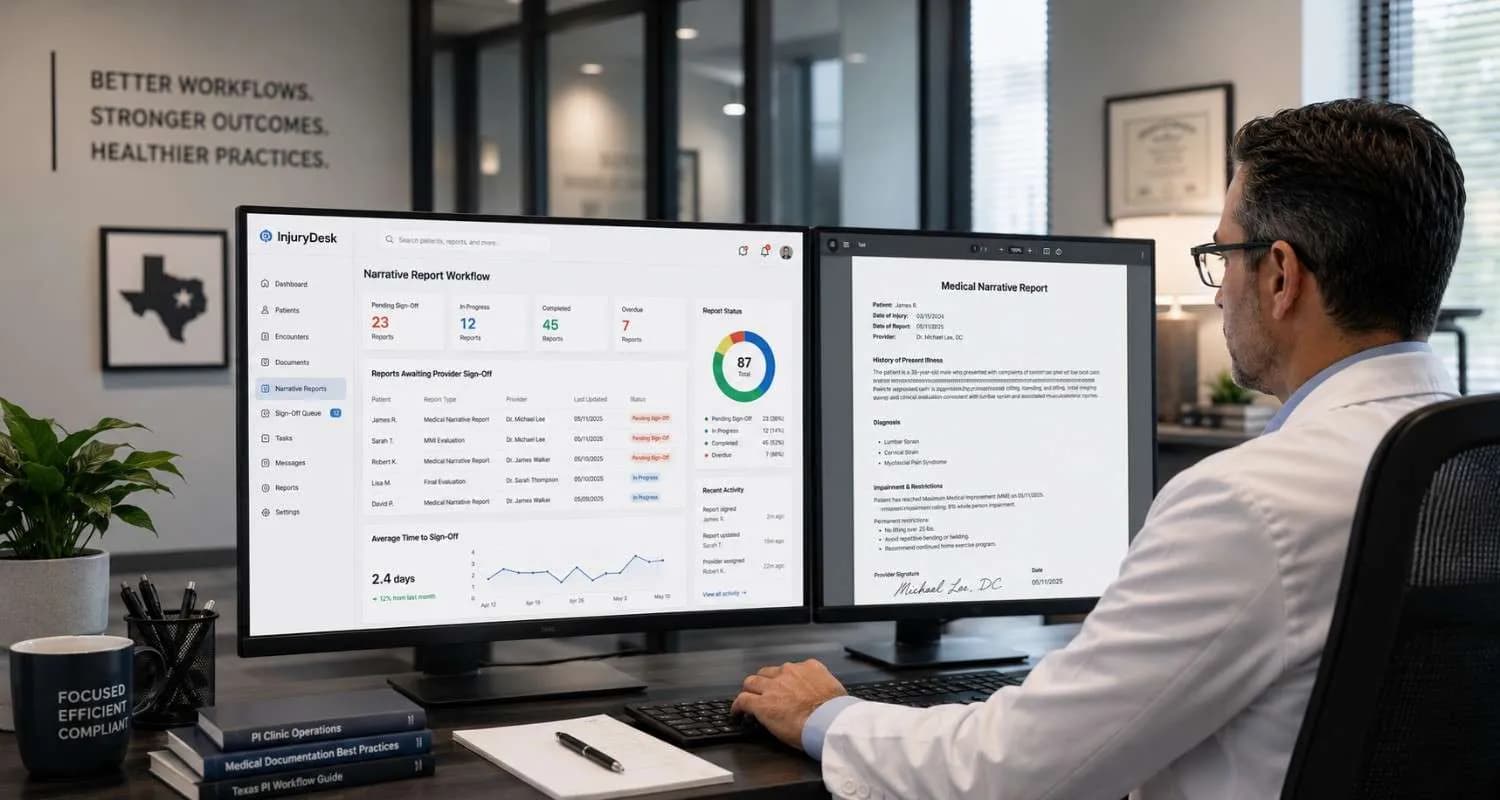

If your Texas PI clinic is managing LOP cases without a real-time LOP case tracking system Texas clinics depend on, you are already losing money — you just cannot see where. Most clinic owners believe their workflows are functioning. The front desk is busy. Patients are coming in. Attorneys are sending referrals. But underneath that surface-level activity, open LOP cases are quietly aging, documentation is stalling, and settlement timelines are slipping by weeks — sometimes months.
Synectus™ works with injury clinics across Texas, and the pattern is almost always the same: intake gets attention, but everything that follows — treatment progression, attorney coordination, documentation tracking — falls into a workflow black hole. The InjuryDesk™ PI clinic management software and PULSE Method™ were built to eliminate that blind spot and restore full operational visibility across every open LOP case.
Why Most Texas PI Clinics Lose Visibility After the Initial LOP Intake
The breakdown rarely happens at intake. Most clinics have reasonable intake processes — LOPs are signed, patients are scheduled. The operational collapse happens the moment that patient walks out of the intake room.
From that point forward, the case exists across at least four disconnected systems: the appointment scheduler, billing platform, front desk notes, and email-based attorney coordination. None of these systems talk to each other. Nobody has a unified view of all open LOP files simultaneously.
Consider this real scenario: a front desk coordinator assumes imaging records were sent to the attorney after an MRI. The attorney never received them. Treatment pauses. The demand package gets delayed. A case that could have settled in four months now extends to seven — quietly, invisibly. Multiplied across 30 to 40 open cases, that invisible lag becomes serious revenue loss.
This is exactly why patient intake workflow automation must extend beyond intake and maintain visibility through every phase of the LOP lifecycle.
The Hidden Revenue Damage Caused by Poor LOP Case Tracking
Most revenue loss in a Texas PI clinic is not visible on any financial statement. It hides inside workflows — in the gap between what staff believe is happening and what is actually happening across open LOP cases.
Here is where the leakage accumulates most consistently:
Delayed settlements
From stalled attorney communication push receivables well beyond acceptable timelines. Even a handful of stuck LOP cases can quietly hold back tens of thousands in collectible revenue.
Untreated care gaps
Occur when patients stop attending mid-treatment and no workflow trigger flags the inactivity. The treatment plan becomes incomplete, the case value weakens, and the settlement drops.
Aging accounts receivable
Stack up when Texas PI clinic operations lack a centralized reporting layer that flags cases by age, status, and financial readiness.
The damage is not one dramatic failure. It is the cumulative weight of dozens of small, invisible gaps repeating across every open LOP case in the portfolio — every single month.
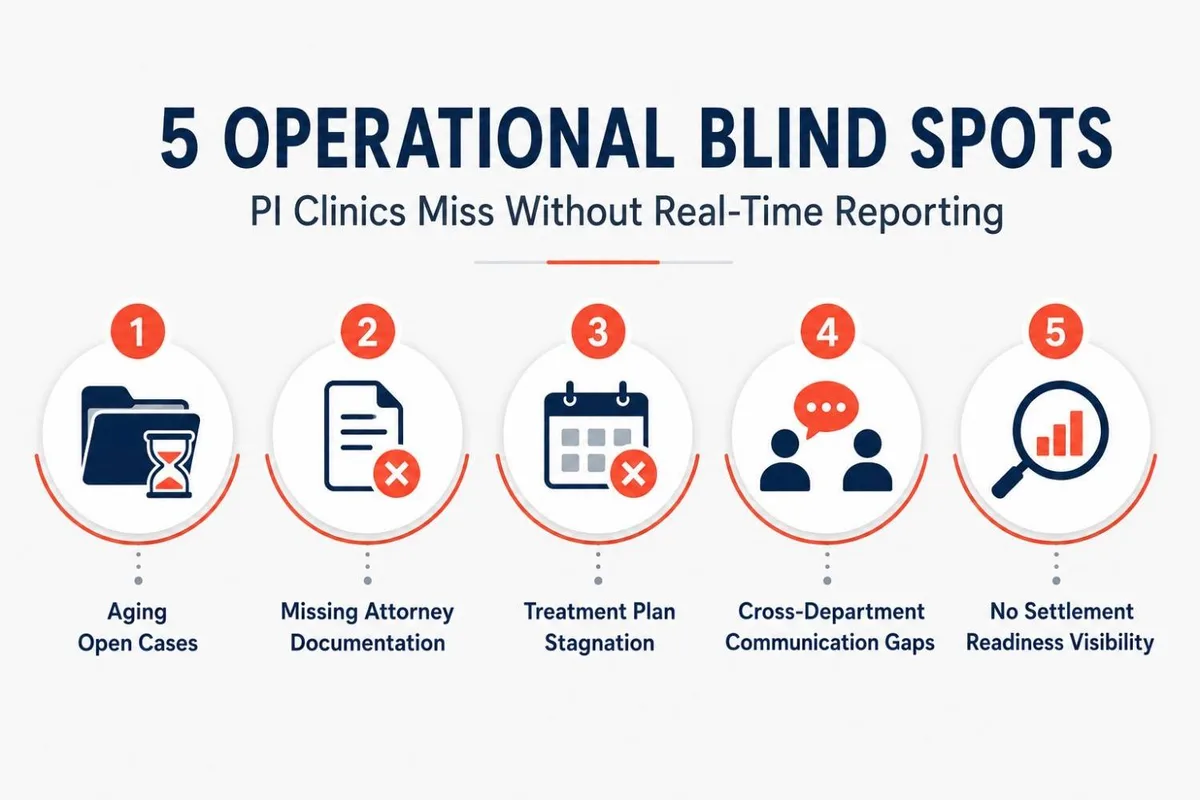
The 5 Operational Blind Spots PI Clinics Miss Without Real-Time Reporting
This is where PI clinic workflow visibility separates clinics that scale from clinics that plateau. Without a real-time LOP case tracking system Texas clinics can rely on, these five blind spots quietly damage performance month after month.
1. Aging Open Cases
Cases sitting inactive for 45 to 90-plus days with no workflow escalation trigger are a direct liability. Without automated case-status reporting, no one knows a case is stalled until the attorney calls.
2. Missing Attorney Documentation
Records requests never completed. Imaging reports never confirmed. Proper medical documentation coordination is a known bottleneck in personal injury workflows, especially when clinics lack centralized tracking systems, as discussed by the American Bar Association.
3. Treatment Plan Stagnation
Patients who disappear mid-treatment represent lost clinical revenue and weakened case value. If no system flags inactivity after a missed appointment threshold, the case drifts undetected.
4. Cross-Department Communication Gaps
Billing, front desk, clinical providers, and legal coordinators all touch the same LOP case from completely different systems. Without a unified communication layer, critical updates are missed or contradicted. PI clinic workflow visibility across departments is an operational requirement — not optional at any meaningful scale.
5. No Settlement Readiness Visibility
The most financially damaging blind spot: the clinic cannot identify which cases are ready to close. Without settlement progression monitoring, collectible revenue sits waiting with nobody actively managing its movement.
These are not hypothetical risks. They are the daily operational reality inside clinics that lack LOP case management software built for the complexity of PI workflows.
Why Spreadsheet-Based LOP Tracking Stops Working as Clinics Grow
Spreadsheets work when a clinic has 15 to 20 active LOP cases and one coordinator who has memorized every patient's status. They stop working the moment that person leaves, or case volume doubles.
The core failure of spreadsheet-based tracking is that it requires constant manual updates — every record sent, every appointment missed, every attorney response needs someone to open a file and update a row correctly. That process has a failure rate that compounds directly with volume.
At 250 active LOP cases — a realistic volume for a mid-size Texas PI clinic — a spreadsheet is not a tracking system. It is a liability. There are no automated alerts, no escalation triggers, no cross-location visibility. The operational lag that spreadsheets create is measurable revenue delay, not just inefficiency.
Synectus™ is an operational systems partner — not a generic marketing agency — built to help Texas PI clinics replace fragmented spreadsheet systems with injury clinic automation. Texas practices need to scale without chaos.
How Delayed Attorney Communication Slows Down Case Progression
Attorney-clinic coordination is the most underestimated bottleneck in LOP workflow automation Texas. Most clinics assume the attorney is handling their side. Most attorneys assume the clinic is on top of documentation. Neither side has real-time visibility into what the other is waiting for — and cases stall silently in the middle.
A realistic workflow breakdown that repeats constantly in under-automated clinics:
Patient → MRI ordered → records delayed → attorney waiting → demand package stalled → settlement extended by 60 to 90 days.
Each step is a point where an automated workflow trigger would have surfaced the delay before it compounded. Without centralized communication tracking, the clinic cannot know the case is stuck — until the attorney calls asking why nothing has moved. Delays tied to medical record handling and legal documentation requests are also widely recognized across healthcare compliance workflows by the HIPAA Journal.
LOP workflow systems for Texas clinics that include attorney communication tracking close this gap by creating documented, real-time visibility into every pending request, every response received, and every stage waiting on legal coordination.
The Difference Between Case Volume and Case Visibility
More patients does not mean operational control. This is the distinction most Texas PI clinic owners miss as they scale.
A clinic managing 300 open LOP cases with no centralized tracking is not successful — it has 300 potential revenue leakage points and no way to identify which ones are actively bleeding.
Clinic A:
300 open cases. No centralized workflow tracking. Staff reacting to whatever surfaces loudest. No aging reports. No settlement readiness flags.
Clinic B:
180 open cases. Centralized LOP dashboard. Proactive escalation alerts. Documented attorney coordination. Daily case-status reporting.
Clinic B collects faster, scales cleaner, and operates without the chaos that eventually forces Clinic A to stop accepting new referrals just to manage the backlog.
The PULSE Method™ from Synectus™ is the framework that moves clinics from Clinic A's operational model to Clinic B's — by installing the visibility infrastructure that makes proactive case management possible at any volume.
How InjuryDesk™ Creates Real-Time Visibility Across the Entire LOP Workflow — A Real-Time LOP Case Tracking System Texas PI Clinics Can Trust
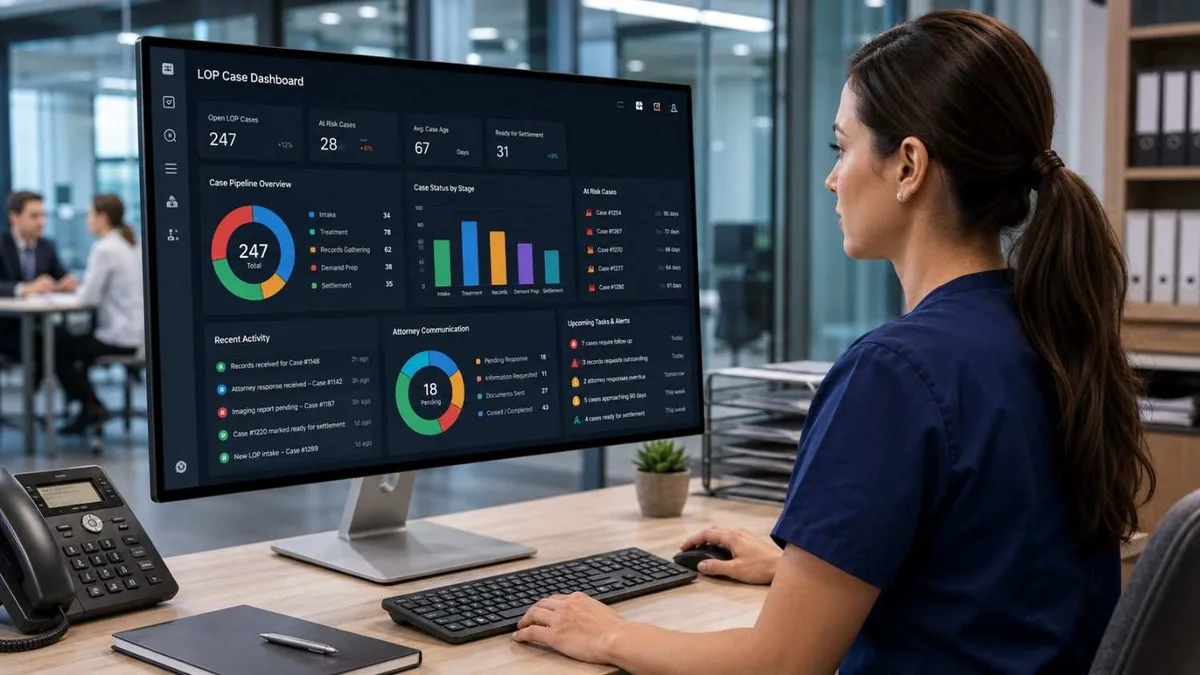
InjuryDesk™ PI clinic management software is not generic software adapted to a PI context. It is a purpose-built operational command center designed specifically for the workflow complexity of Texas PI clinic operations — from LOP intake through final settlement.
Here is what real-time visibility looks like inside InjuryDesk™:
Centralized LOP Dashboard
Every open case, its current status, its age, assigned attorney, and outstanding documentation requirements visible in one unified operational view. No spreadsheets. No phone calls to confirm status.
Real-Time Case-Status Visibility
Each case moves through defined workflow stages. When a case stalls — a record not received, an appointment missed, an attorney response overdue — the system surfaces it automatically.
Attorney Communication Tracking
Every outbound record request, every attorney response, every outstanding documentation item is logged and trackable. The clinic always knows exactly what it is waiting for — and from whom.
Workflow Escalation Alerts
When a case crosses defined aging thresholds, designated staff receive automated escalation notifications. Stalled cases get flagged, assigned, and resolved before they become revenue problems.
Settlement Progression Monitoring
The system identifies which cases are approaching settlement readiness so the clinic can coordinate proactively with attorneys — turning aging receivables into collected revenue faster.
This is what a real-time LOP case tracking system Texas PI clinics need at scale — not a better spreadsheet, but a complete PI clinic case tracking system built around operational accountability from intake to settlement.
Building a Centralized LOP Tracking System for Multi-Location Texas PI Clinics
Scaling from one location to three or five introduces a new operational risk: inconsistency. Each location develops its own LOP tracking habits. Each front desk team manages attorney coordination differently. Clinic ownership has no centralized view of performance across any of them.
Building a centralized tracking system across multiple locations requires standardized workflow infrastructure at every level: unified intake processes, consistent documentation protocols, shared attorney communication systems, and cross-location reporting that gives ownership real visibility into case performance at every site. Operational benchmarking organizations like MGMA have consistently emphasized the importance of centralized reporting and operational standardization for growing medical practices.
The PULSE Method™ (P- Pipeline, U - Usher, L - Look After, S - Support, E - Execute) is the systems architecture for this operational scalability — defining how LOP cases flow from intake to settlement across every location, department, and staff role. When combined with InjuryDesk™ as the operational technology layer, multi-location Texas PI clinics gain the standardized workflows and centralized reporting infrastructure that makes consistent performance possible — regardless of how many locations the practice operates.
Book a Free PI Clinic Workflow Audit With Synectus™
Texas PI clinics do not lose revenue because they lack patients. They lose revenue because they lack operational visibility into the workflows attached to those patients.
If your clinic is managing active LOP cases without a real-time LOP case tracking system Texas clinics need for intake-to-settlement visibility, every day that passes means more invisible revenue leakage, more stalled settlements, and more operational bottlenecks compounding with every new referral.
Synectus™ is the operational systems and PI clinic workflow automation partner for Texas PI clinics that are serious about building scalable, visible, and accountable LOP workflows. We build operational infrastructure — centralized reporting, attorney-clinic coordination systems, intake-to-settlement tracking — designed specifically for the complexity of injury clinic automation Texas requires.
Book your free PI clinic audit and get a complete operational visibility assessment of your LOP workflows, attorney coordination systems, and case tracking infrastructure — with specific, actionable recommendations for eliminating the blind spots costing your clinic thousands every month.
Related reading
Next step
See how Synectus closes the handoff after the lead arrives.
If this article describes the exact gap inside your clinic, go one layer deeper into the service stack or book a direct strategy call with Synectus.