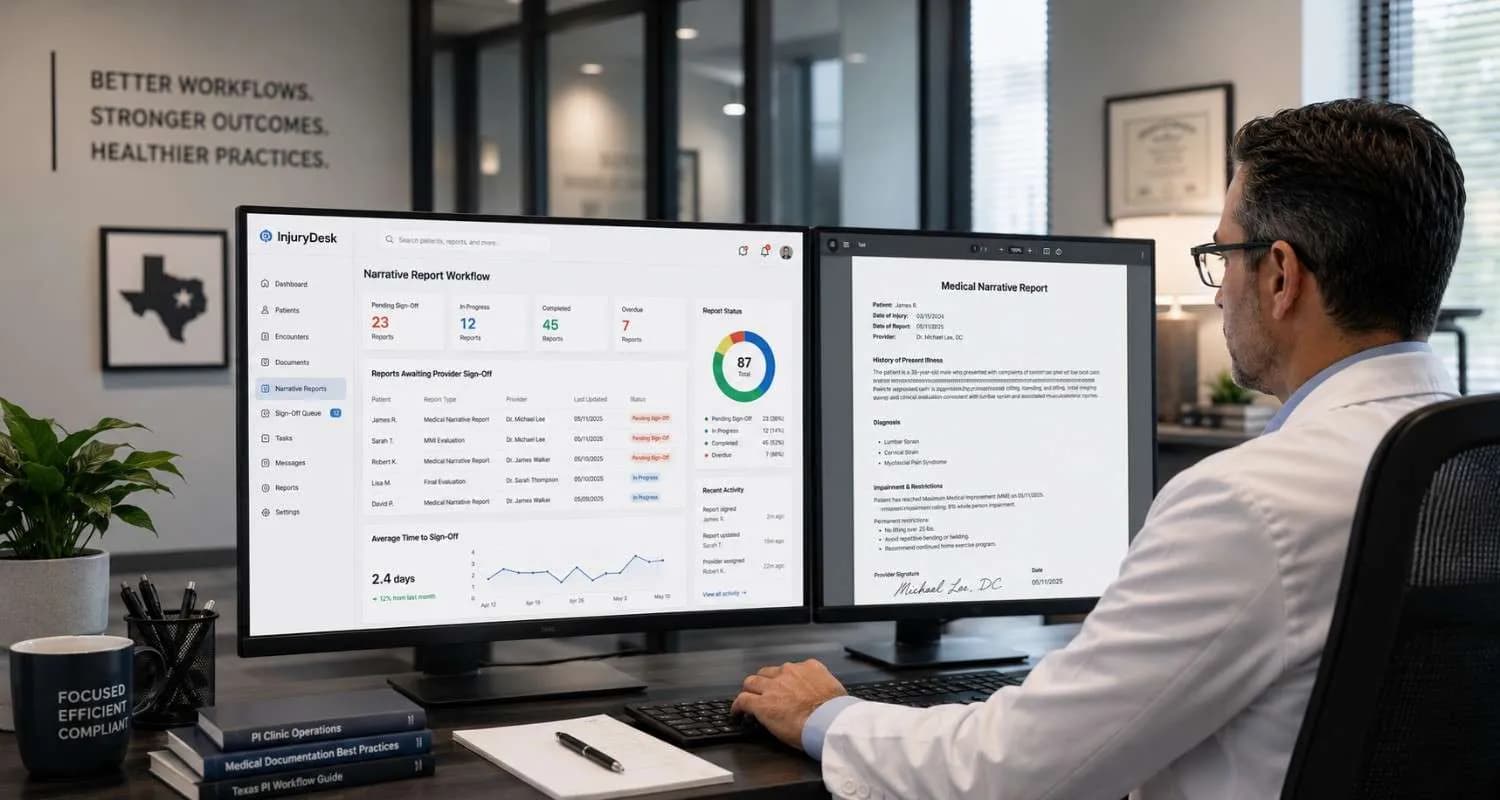
Most Texas PI clinic owners believe their revenue problem lives at the billing stage. It doesn't.
LOP cases Texas PI clinic operations silently lose thousands every month — not because of billing errors, but because of structural failures that begin at intake and compound through lien documentation, attorney communication, and settlement follow-up. By the time the damage is visible, revenue that was already earned has quietly disappeared across four distinct operational stages.
This is not a cash flow issue. This is a PI clinic revenue leakage problem — a case lifecycle breakdown that is entirely preventable with the right systems in place.
Below is an exact stage-by-stage breakdown of where your LOP revenue is leaking — and how InjuryDesk™ automated LOP workflow software closes every gap.
What Is an LOP Case Leak — And Why Most LOP Cases Texas PI Clinics Go Undetected
A case leak in the context of PI clinic operations is not a single failure. It is a series of invisible disconnects across the case lifecycle that collectively result in lost, delayed, or uncollectible revenue.
Unlike billing errors that appear in denial reports, LOP case leaks are structural. They hide inside manual workflows, undocumented intake steps, and fragmented communication between your clinic and the attorneys who control settlement timelines.
The danger is compounding: each stage of leakage makes the next stage worse. A patient who enters intake without LOP classification creates a billing mismatch. That mismatch creates lien documentation gaps. Those gaps create attorney friction. And that friction results in cases sitting unresolved for months — sometimes permanently.
According to the American Health Information Management Association (AHIMA), documentation gaps are among the leading causes of denied claims and revenue delays in specialty medical practices. For PI clinics operating on a lien-based model, the financial impact is amplified significantly.
In most clinics, the case shows as active in the system — but it is financially invisible.
Stage 1 — The Leak Starts at Patient Intake

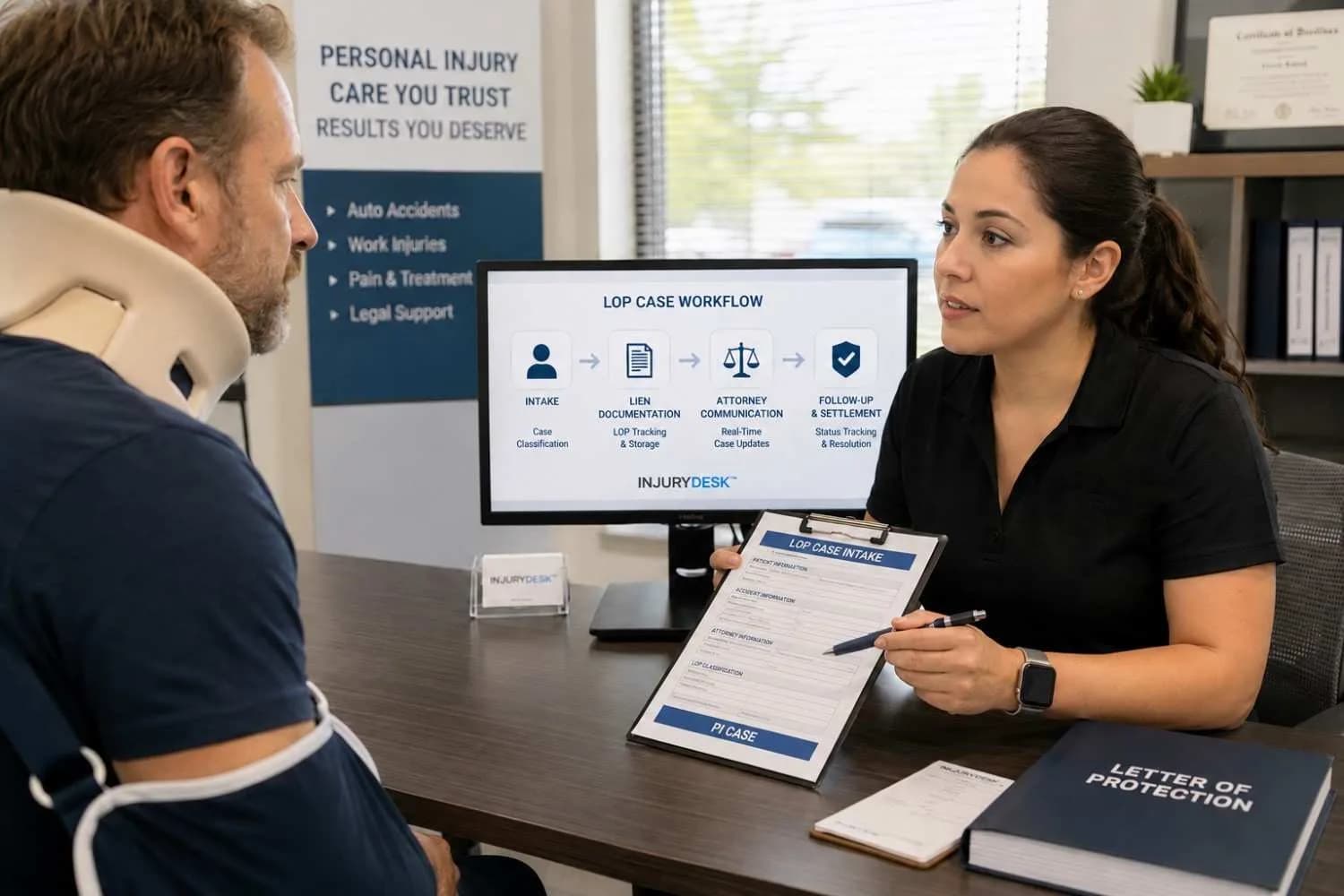
Every personal injury billing workflow depends on one foundational step: correct case classification at intake. When a patient arrives following an accident, their case type must be identified, tagged, and structured from the moment they walk in.
In most Texas PI clinics, this does not happen consistently.
Common Intake Failures
- No LOP tagging assigned at patient registration
- Missing attorney name or referral source on intake form
- Accident type recorded as a general visit rather than a PI case
- Staff relying on verbal communication instead of structured intake protocols
- No digital audit trail connecting patient entry to case classification
The consequence is severe. A case that enters your system without proper LOP classification cannot be tracked, billed, or reported accurately. Your billing team operates on incomplete data. Your front office cannot identify which cases require lien documentation. Your downstream collections become unreliable.
The Medical Group Management Association (MGMA) reports that front-end errors — including incomplete intake — account for over 30% of preventable claim denials. In lien-based PI practices, that figure is even more damaging because the financial stakes extend beyond insurance to legal settlement.
This is why Synectus's patient intake workflow service is built around structured, PI-specific intake protocols that eliminate classification errors from Day 1.
Stage 2 — Lien Documentation Gaps That Kill Revenue
If intake is where the leak begins, lien documentation is where LOP cases Texas PI clinic operations lose the most recoverable revenue.
A Letter of Protection is only enforceable if it is properly signed, stored, and tracked. Yet this is the stage where the process breaks down most commonly — and most expensively.
Typical Lien Documentation Texas Failures
- Unsigned or partially executed LOP agreements
- No centralized digital storage for lien documents
- Multiple document versions with no audit trail
- Delayed or absent attorney lien confirmation
- Inconsistent template formats across clinic locations
Each of these failures directly reduces your legal claim on settlement proceeds. Without a signed and fully tracked LOP, your clinic is providing treatment on goodwill — not secured documentation. That is a position no clinic owner should accept.
The Texas Department of Insurance and related personal injury legal frameworks in Texas require clinics to maintain clear documentation of all lien agreements as part of proper PI case management. Clinics that fail to meet these standards risk not just delayed collections, but potential compliance exposure.
Synectus's LOP management system provides standardized lien templates, centralized digital storage, and real-time audit visibility — ensuring every document is complete, signed, and legally traceable.
For clinics managing medical records across cases, the medical records legal support service ensures documentation integrity from treatment through settlement.
Stage 3 — Attorney Communication Breakdown
This is the stage most clinic owners consistently underestimate: attorney-clinic communication breakdown is not an administrative inconvenience — it is a direct revenue control failure.
Every LOP cases Texas PI clinic workflow depends on a functional working relationship between your operations team and the attorneys managing your patients' legal cases. When that relationship is fragmented, your entire case lifecycle stalls.
What Breaks Down in Most PI Clinics
- Case updates sent via email with no tracking or confirmation
- No dedicated attorney portal for real-time status visibility
- Staff manually following up by phone — inconsistently
- Attorneys receiving different information from different staff members across locations
- No structured escalation protocol when attorney responses are delayed
When attorneys cannot get clear, timely updates from your clinic, two damaging outcomes follow. First, they deprioritize your cases in favor of clinics with cleaner communication systems. Second, they begin referring patients elsewhere.
The American Bar Association has consistently noted that communication quality is among the primary factors attorneys consider when establishing long-term referral relationships with medical providers. A broken communication process costs you not just current cases — but your future referral pipeline.
Synectus's attorney-clinic communication service eliminates manual dependency by creating structured, real-time communication channels between your clinic and your legal network — protecting both your case flow and your referral relationships.
Stage 4 — No Follow-Up System = Lost Cases
The final stage of LOP case leakage is the most operationally embarrassing — and also the most common.
Once a PI case moves past treatment and into the settlement phase, most Texas PI clinics have no systematic way to track what happens next. Cases sit in an informal "pending" status with no escalation triggers, no resolution timelines, and no visibility. Completed treatment quietly fails to convert into collected revenue.
In multi-location LOP cases Texas PI clinic environments, this problem multiplies. Each location may have different staff chasing follow-ups in different ways — or not chasing them at all. There is no unified dashboard, no escalation protocol, no accountability layer.
Becker's Hospital Review has reported that delayed follow-up on outstanding medical claims is one of the top three drivers of practice revenue loss, particularly in specialty and injury-focused clinical settings.
In reality, this is not a delay. This is pure system failure — and it is recoverable with the right infrastructure.
Synectus's case status tracking system provides automated settlement dashboards, escalation triggers for delayed cases, and unified reporting across locations — turning passive follow-up into active, measurable medical lien management.
How InjuryDesk™ Plugs Every Stage of the LOP Leak
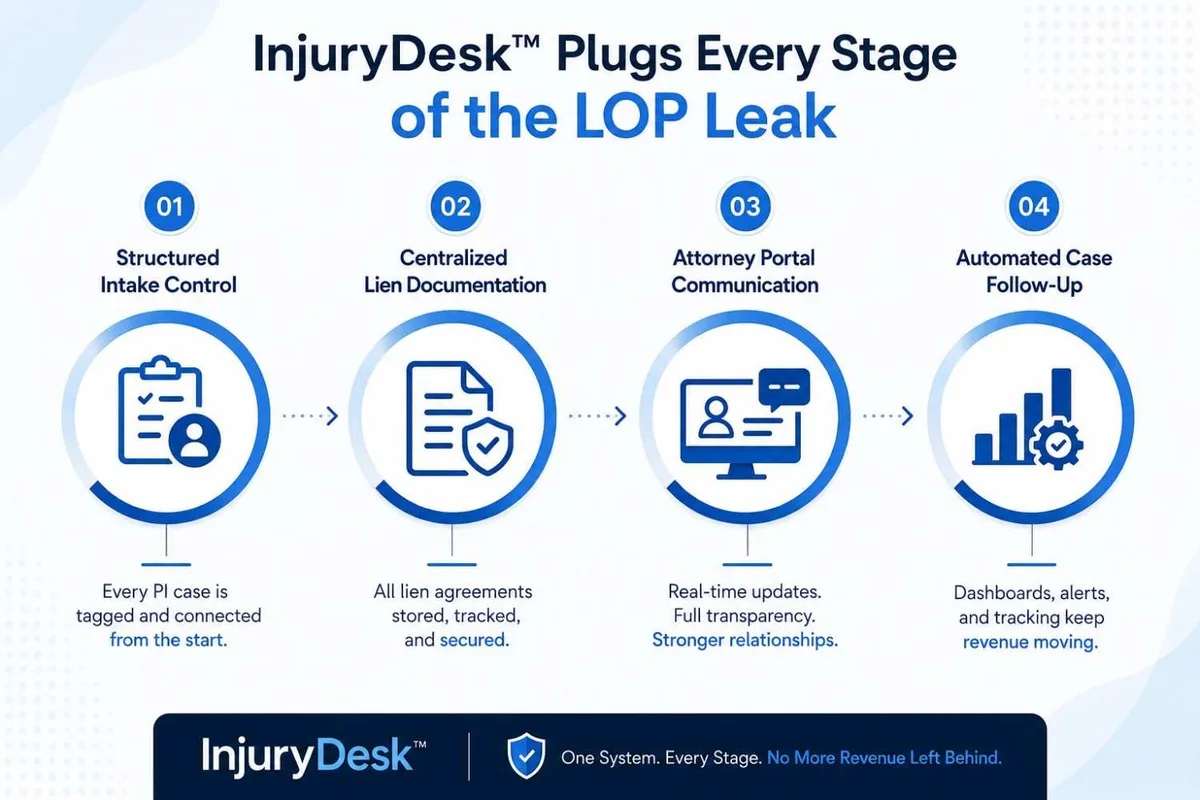
Every stage of the LOP case leak has a direct system fix. That system is InjuryDesk™ automated LOP workflow software — built specifically for the operational realities of LOP cases Texas PI clinic management. Here is exactly how InjuryDesk™ closes each leak point:
Stage 1 Fix — Structured Intake Control:
InjuryDesk™ enforces PI-specific intake classification at registration. Every patient entering as a personal injury case is tagged, assigned an LOP status, and connected to attorney information before they leave the front desk. No manual entry. No missing classification.
Stage 2 Fix — Centralized Lien Documentation:
All lien agreements are stored in a single, auditable digital system. Standard templates are applied across every location. Signature status is tracked in real time. No more missing agreements. No more unsigned documents creating legal exposure.
Stage 3 Fix — Attorney Portal Communication:
InjuryDesk™ includes a structured attorney communication portal that provides real-time case updates without relying on untracked phone calls or email chains. Attorneys see exactly where each case stands — and your clinic maintains full control of the information.
Stage 4 Fix — Automated Case Follow-Up:
Settlement tracking dashboards flag delayed cases automatically. Escalation alerts prevent revenue from sitting uncollected. Every location operates from the same unified reporting layer with full visibility.
Explore the complete InjuryDesk™ features to see exactly how this infrastructure applies to your clinic's specific case volume and location structure.
Powered by the PULSE Method™
Every Synectus engagement — including InjuryDesk™ implementation — operates through the PULSE Method™, Synectus's proprietary operational framework designed for PI clinic environments:
P — Pipeline:
Building a structured, trackable pipeline for every LOP case from intake through to settlement — ensuring no case becomes financially invisible.
U — Usher:
Guiding patients and cases through each workflow stage without manual dependency — removing the human error that causes most operational leaks.
L — Look After:
Proactive lien documentation monitoring and audit management — so every signed agreement is stored, tracked, and legally defensible.
S — Support:
Ongoing attorney communication and case lifecycle support — maintaining referral relationships and keeping settlement timelines on track.
E — Execute:
Full operational execution with real-time reporting and escalation systems — turning passive case management into a controlled, measurable revenue system.
This is not a marketing framework. It is the operating system that makes InjuryDesk™ function at a clinic infrastructure level — not just as software, but as a managed revenue recovery system.
For multi-location Texas PI clinics, the PULSE Method™ ensures the same process runs with the same reliability across every site. Learn more about Synectus's approach for PI injury clinics across Texas.
Stop the Leak Today — Book Your Free Strategy Call
Every day your clinic runs without a structured LOP case management system is another day revenue leaks out at stages you cannot see, cannot measure, and cannot recover.
The problem is not the number of cases you handle. The problem is the visibility and control you have over each case — from intake to settlement. PI clinic revenue leakage at four compounding stages does not self-correct. It requires a system.
Synectus works with Texas PI clinics to identify exactly where LOP revenue is leaking, build the operational infrastructure to stop it, and implement InjuryDesk™ as the system layer that makes clinic revenue predictable and scalable.
Here is what happens when you book your call:
- A complete operational audit of your current LOP workflow and case classification process
- Identification of every active leak stage in your case lifecycle — from intake through settlement
- A structured plan for InjuryDesk™ implementation and PULSE Method™ integration
- No obligation. No generic consultation. A targeted operational review for clinic owners ready to stop losing earned revenue.
Book your free PI clinic strategy call — and get a full LOP workflow audit at no cost.
You can also explore our dedicated Texas PI clinic operations services or contact our team directly to get started.
Related reading
Next step
See how Synectus closes the handoff after the lead arrives.
If this article describes the exact gap inside your clinic, go one layer deeper into the service stack or book a direct strategy call with Synectus.