ORTHOPAEDIC PRACTICES — TEXAS
Orthopaedic Practice Marketing & Operations in Texas
For Texas orthopaedic practices that need stronger patient acquisition, cleaner intake flow, and operational discipline that matches the complexity of high-value specialty care.
Best fit
Who this operating model is built for.
Who we serve
This is the profile that fits the model.
Synectus works best where operational complexity and growth pressure are tied together instead of sitting in separate teams.
Profile 01
Orthopaedic practices competing in Texas specialty care markets where local search visibility and referral strategy need to work together
Profile 02
Clinics managing complex appointment flows across multiple providers with documentation and records requirements that standard workflows underserve
Profile 03
Leadership teams that need better operational visibility without adding management overhead to an already stretched administrative staff
Common challenges
Where operators usually lose speed and control.
Challenge
Specialty demand is highly competitive
Search visibility and patient trust need to be built deliberately in orthopaedic markets where multiple strong competitors are targeting the same local keywords and referral relationships.
Challenge
Operational inefficiency is expensive at specialty pricing
Intake delays, scheduling gaps, and records friction create disproportionate cost in orthopaedic practices where each missed appointment or delayed billing event represents significant revenue.
Challenge
Leadership cannot see the full operational picture
When billing, scheduling, intake, and records run through separate systems with no unified reporting, problems become visible only after they have been compounding for weeks.
Strong fit signs
The model fits best when workflow clarity is already a commercial priority.
Authorization delays for imaging or procedures are stalling patient timelines and nobody owns pushing them through
Multiple providers touch the same case without a shared view of where records and scheduling currently stand
Referral relationships with PCPs and other specialists need active management, not just a fax number
Records requests and audit-readiness questions take longer to answer than a specialty this documentation-heavy should allow
Operating reality
This industry usually needs a system view before it needs another isolated tactic.
Orthopaedic care runs through more authorization gates than most specialties: imaging, surgical scheduling, and procedure approval each require payer sign-off before the next step can move, so a single stuck authorization can stall a patient's entire care timeline, not just one appointment.
Multi-provider scheduling adds a coordination layer routine visits do not have: a single case might touch a surgeon, a physician assistant, and a referring PCP or physical therapist, and if those calendars are not coordinated against the same records, the patient becomes the one relaying information between providers who should already have it.
Documentation depth is a cost centre here in a way it is not elsewhere. Surgical and specialty records need to be complete, retrievable, and audit-ready — for payers, for referring providers, and sometimes for legal purposes — and a records process built for routine visits does not hold up under that requirement.
The practices that manage this well treat authorization tracking, multi-provider coordination, and records depth as three deliberate systems, not three things a stretched administrative team is expected to hold together from memory.
How Synectus helps
The service mix changes by specialty, but the standard stays high.
PULSE alignment
How the framework maps to this industry.
This industry typically fits Level 1: Pipeline, Usher, Look After, and Support.
The PULSE Method™
A five-phase operating system built around the PI patient journey — so you treat patients while Synectus runs everything else.
Pipeline
We audit your referral sources, build your local patient acquisition channels, and run SEO, Google Ads, and referral campaigns specific to your PI clinic's Texas market. Your schedule fills — without you managing a single campaign.
- Referral source audit
- Local SEO + Google Ads for PI clinics
- Competitive gap analysis
Framework to platform
Where the operating model becomes something the team can actually run.
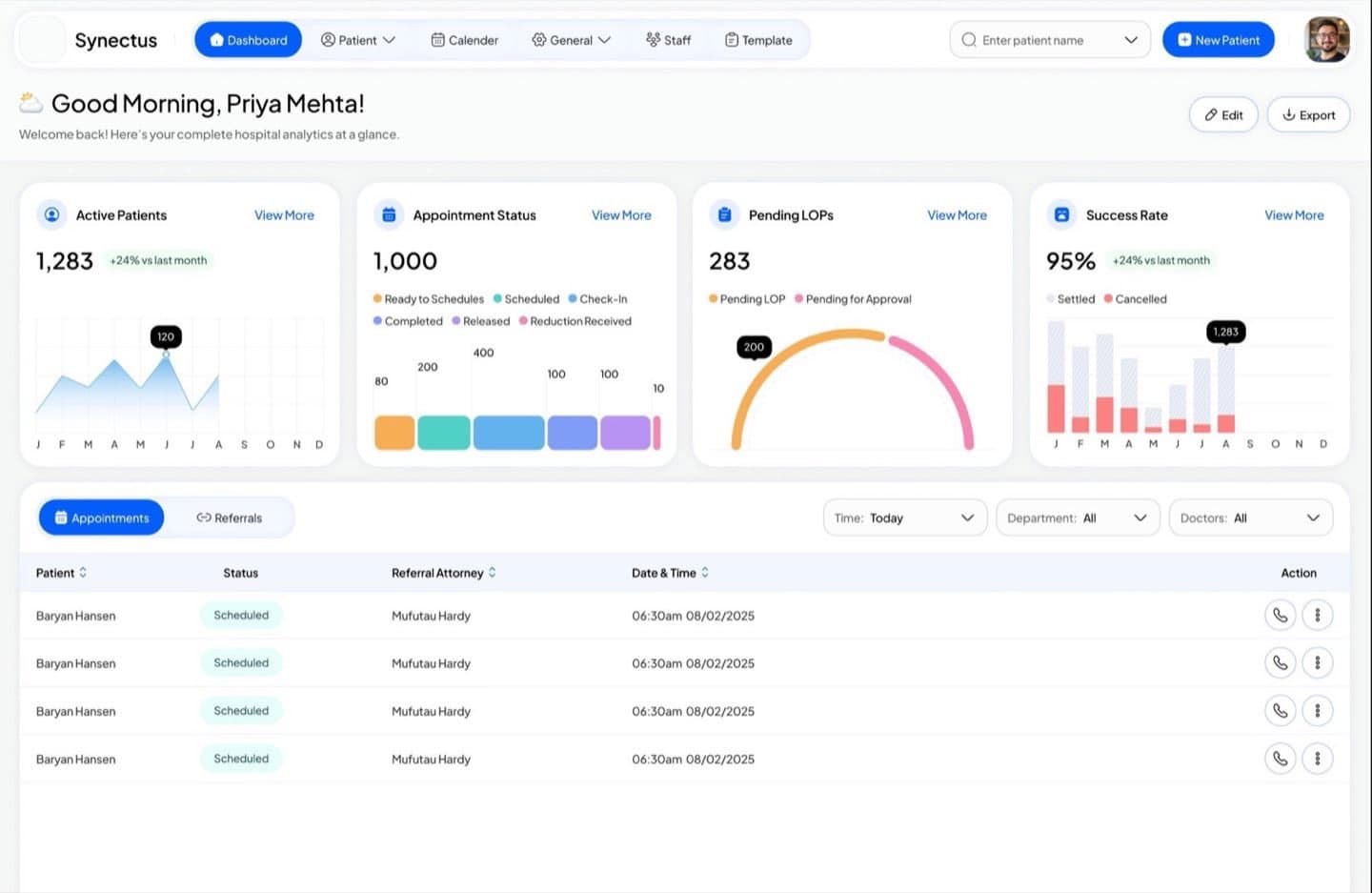
PULSE defines how the clinic should move. InjuryDesk is the software layer that keeps those handoffs visible, owned, and trackable day to day.
Transition point
Authorization status in one place
Where each case sits in the imaging or procedure authorization process stays visible, so a stalled approval gets caught before it stalls the patient's care timeline.
Transition point
Coordinated multi-provider scheduling
Surgeon, PA, and referring-provider calendars work against the same record instead of each provider working from a different version of the case.
Transition point
Audit-ready documentation
Records stay organised and retrievable enough to answer a payer, referring-provider, or legal request without a scramble through separate systems.
InjuryDesk™ — PI Clinic Software Built for Texas
The only PI clinic management software that connects intake, lien tracking, EMR integration, billing, and attorney communication in one platform — purpose-built by people who also run PI clinic operations.
- HIPAA-Compliant Documentation
- Direct EMR/EHR Integration
- Automated Lien Letter Generation
- Attorney Portal Access
Common questions
The concerns that usually need answering before a decision.
Book Your Free
Strategy Call.
In 30 minutes, we'll audit your current patient acquisition, operations, and PI workflow — and show you exactly where Synectus can help.


Texas-based team. Responds same day.