TEXAS PAIN MANAGEMENT CLINICS
Pain Management Clinic Marketing & Operations in Texas
For Texas pain management clinics where patient acquisition, scheduling pressure, billing complexity, and PI case workflow are all competing for attention at the same time.
Best fit
Who this operating model is built for.
Who we serve
This is the profile that fits the model.
Synectus works best where operational complexity and growth pressure are tied together instead of sitting in separate teams.
Profile 01
Pain management practices balancing referral-based and direct patient acquisition across Texas markets
Profile 02
Clinics with rising administrative load across intake, insurance verification, and billing coordination
Profile 03
Practices handling personal injury cases that need operational structure beyond a standard marketing retainer
Common challenges
Where operators usually lose speed and control.
Challenge
Inconsistent patient demand
Growth can look strong one month and soft the next because acquisition channels and intake follow-up are not connected tightly enough to produce a predictable schedule.
Challenge
Operations stretched across too many moving parts
Front-office and back-office teams handle intake, verification, scheduling, and billing without a unified system — creating gaps that become revenue problems later.
Challenge
PI case complexity adds operational drag
As injury-linked cases grow, the lien management, attorney coordination, and case visibility requirements that come with them exceed what a standard clinic operation was built to handle.
Strong fit signs
The model fits best when workflow clarity is already a commercial priority.
Referral volume and direct-search volume are both real, but nobody owns the handoff between how each one converts into a scheduled procedure
Prior-authorization delays are absorbing staff hours that should be going into patient care and follow-up scheduling
PI case volume has grown to the point where lien tracking competes with routine billing for the same administrative time
Leadership wants one accountable partner instead of a marketing vendor, a billing service, and a legal-workflow gap with no clear owner
Operating reality
This industry usually needs a system view before it needs another isolated tactic.
Pain management runs two acquisition motions at once — referrals from primary care and orthopaedic partners, and direct search from patients looking for injury or chronic pain relief — and most clinics route both through a single intake process that underserves each one.
Interventional procedures carry more prior-authorization steps and coding variance than a standard office visit, so a billing team sized for routine E&M work runs into rework and payer pushback that a straightforward clinic operation was never built to absorb.
Because injury cases route into pain management at a higher rate than many specialties, lien tracking and attorney coordination become a parallel job sitting on top of the clinic's existing scheduling and billing load rather than an occasional side task.
The practical test: can the clinic say, without pulling three separate reports, which channel produced this month's new patients, which authorizations are stuck, and which PI cases are waiting on documentation? If that takes more than one system to answer, that is the gap this operating model closes.
How Synectus helps
The service mix changes by specialty, but the standard stays high.
PULSE alignment
How the framework maps to this industry.
This industry often benefits from the full Level 2 PULSE cycle.
The PULSE Method™
A five-phase operating system built around the PI patient journey — so you treat patients while Synectus runs everything else.
Pipeline
We audit your referral sources, build your local patient acquisition channels, and run SEO, Google Ads, and referral campaigns specific to your PI clinic's Texas market. Your schedule fills — without you managing a single campaign.
- Referral source audit
- Local SEO + Google Ads for PI clinics
- Competitive gap analysis
Framework to platform
Where the operating model becomes something the team can actually run.
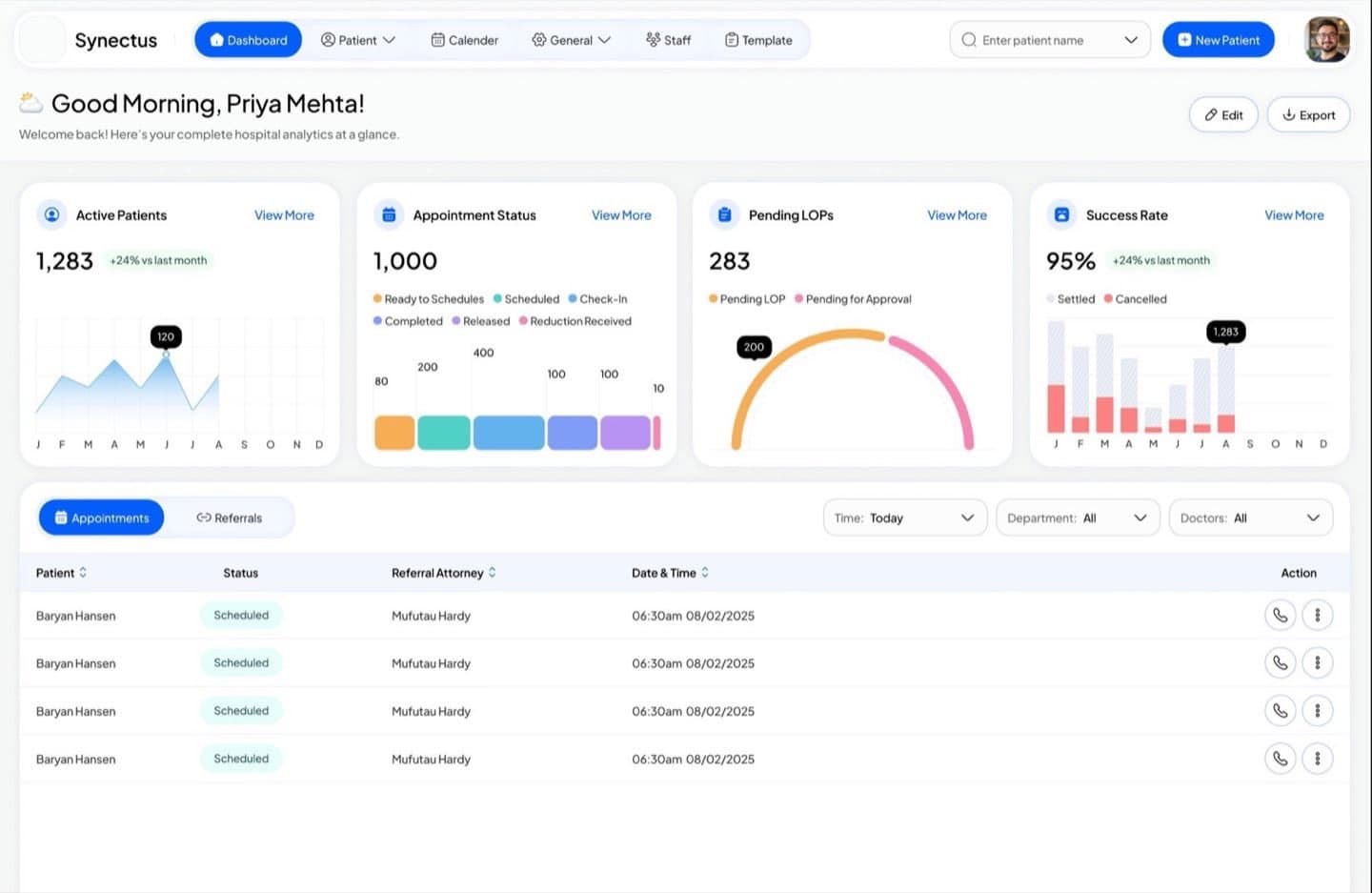
PULSE defines how the clinic should move. InjuryDesk is the software layer that keeps those handoffs visible, owned, and trackable day to day.
Transition point
Authorization tracking
Prior-authorization status for interventional procedures stays visible in one place instead of living in a biller's inbox or a note on someone's monitor.
Transition point
Referral-to-schedule handoff
Referral intake and direct-inquiry intake feed the same scheduling view, so the procedure calendar fills from both channels without double-booking or dropped follow-up.
Transition point
Lien status at a glance
PI case lien and attorney-coordination status sits next to the rest of the patient record instead of in a spreadsheet only one person maintains.
InjuryDesk™ — PI Clinic Software Built for Texas
The only PI clinic management software that connects intake, lien tracking, EMR integration, billing, and attorney communication in one platform — purpose-built by people who also run PI clinic operations.
- HIPAA-Compliant Documentation
- Direct EMR/EHR Integration
- Automated Lien Letter Generation
- Attorney Portal Access
Common questions
The concerns that usually need answering before a decision.
Book Your Free
Strategy Call.
In 30 minutes, we'll audit your current patient acquisition, operations, and PI workflow — and show you exactly where Synectus can help.


Texas-based team. Responds same day.