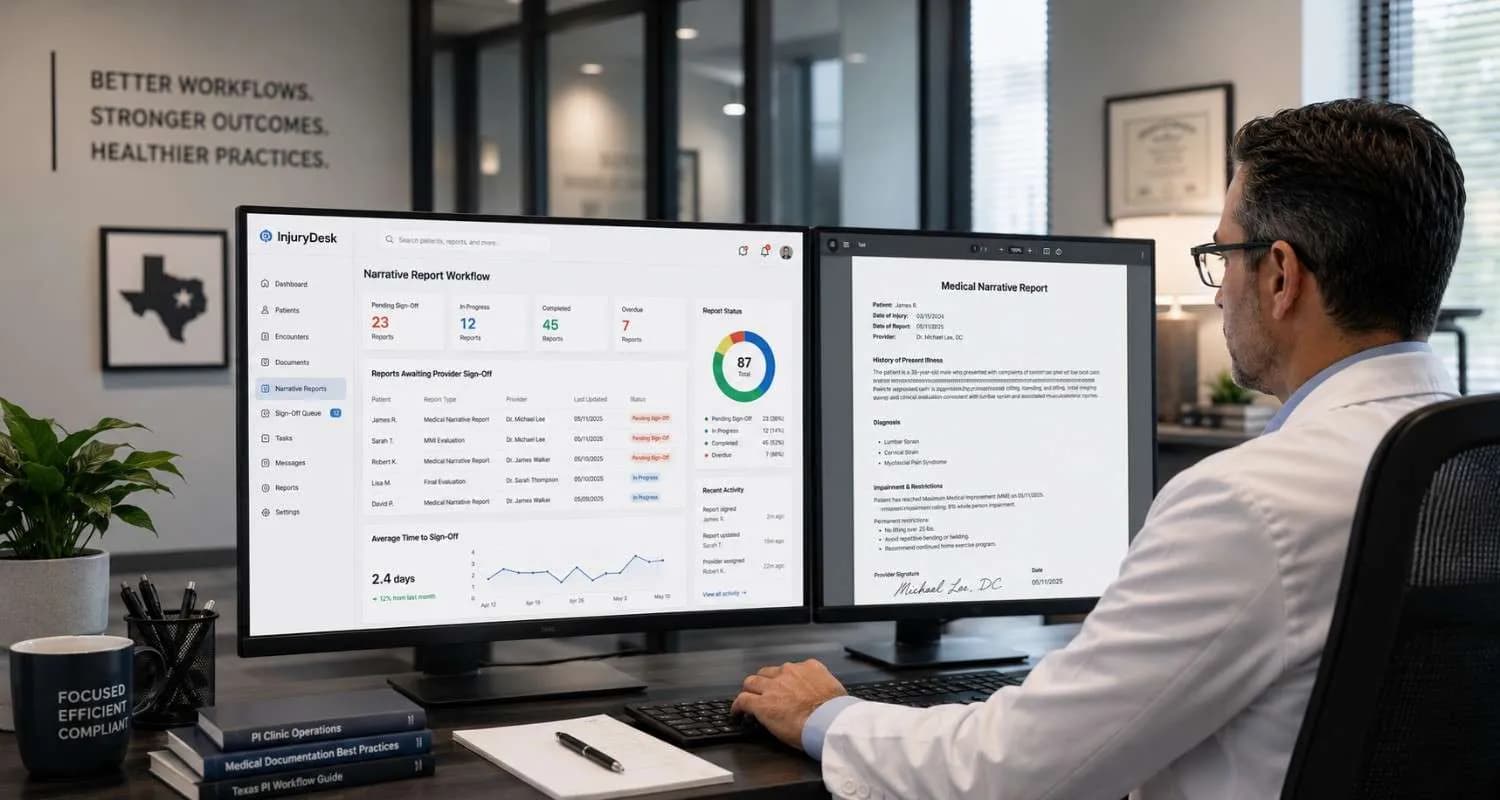

Introduction
Your schedule is full. Your attorneys are slow. Your bank account doesn't lie.
If you run a personal injury clinic in Houston, Laredo, or Beaumont, you already know the feeling — a packed appointment book that somehow doesn't translate into a healthy cash balance. Many clinics dealing with PI clinic cash flow problems Texas lien management breakdowns don't have a patient problem — they have a settlement timing problem. You're not running a busy clinic. You're financing personal injury cases.
Every treatment you deliver under LOP billing Texas clinics is money already spent — money that won't come back until an attorney closes the case. This is the root of PI clinic cash flow problems Texas lien management teams consistently underestimate. And if nobody owns that process inside your practice, that settlement will take months longer than it should. This article breaks down exactly why it happens, what it costs you monthly, and how lien workflow automation through InjuryDesk fixes it permanently — so your revenue finally matches your schedule.
The Texas PI Clinic Paradox — Full Schedule, Broken Cash Flow
LOP-based billing is the defining financial reality of every PI clinic. Unlike standard insurance billing — where payment typically follows treatment within 30 to 45 days — LOP billing in Texas clinics ties your revenue directly to case settlement. You deliver care today. You get paid when the case closes. That gap runs 60 to 120 days, and often much longer.
For a clinic carrying 20 to 30 open PI cases, that means $50,000 to $150,000 in receivables with no predictable arrival date. One delayed case isn't a problem. Twenty untracked cases is a personal injury clinic revenue cycle failure in slow motion.
Your clinic is funding treatments while waiting on attorneys — because nobody owns the process. Staff are focused on patients. Billing teams manage standard insurance claims. Somewhere in between, your PI lien workflow quietly falls apart with no one accountable for it.
Busy clinics don't struggle with volume — they struggle with visibility and control. According to the Healthcare Financial Management Association (HFMA), revenue cycle breakdowns are among the leading causes of cash flow instability for specialty medical practices — and PI clinics operating on LOP are uniquely exposed to this risk.
Read our Houston PI clinic case study to see how one Texas clinic transformed a broken lien workflow into a predictable settlement pipeline.
How PI Clinic Cash Flow Problems Texas Lien Management Failures Start Costing You Thousands

PI clinic cash flow problems Texas lien management failures don't happen because clinic owners aren't working hard. They happen because the lien workflow was never built for the complexity of PI billing. Here are the three most expensive mistakes — with real financial consequences behind each one.
Mistake #1: Lien Letters With No Audit Trail
A lien letter is the legal document that formally establishes your clinic's financial interest in a PI settlement. Without a properly sent, timestamped lien letter, attorneys have no documentation that your clinic holds a stake in the case — and they won't prioritize your file.
In most Texas PI clinics, lien letters are created manually, delayed three to seven days, and sent without any tracking or delivery confirmation. The result: attorneys don't acknowledge receipt, the case timeline starts late, and every day a lien letter sits unsent pushes your payment back across every open case.
The American Health Information Management Association (AHIMA) notes that documentation timeliness and audit trails are foundational to protecting clinical revenue in lien-based billing environments.
Explore how Synectus's LOP management service eliminates this problem with structured lien letter workflows from day one.
Mistake #2: No Structured Attorney Follow-Up
Attorneys manage 50 to 100 active cases simultaneously. They move fastest on the providers who are easiest to work with. If your follow-up process means staff chasing attorneys through phone calls, texts, and untracked email threads, you have already lost your position in the queue.
Without timestamped follow-up records, you have zero leverage. You cannot prove what was communicated, what was requested, or what was promised. PI case settlement delays in Texas routinely stretch 30 to 60 days longer than necessary because no accountability structure exists between attorney and clinic. This is precisely where a structured attorney-clinic communication workflow changes the outcome.
Mistake #3: Incomplete Demand Packets
A demand packet is the complete documentation bundle — treatment summaries, itemized billing logs, clinical notes — submitted to the attorney before settlement negotiation. When any element is missing, the attorney cannot finalize the demand. Settlement stalls. And most clinics never find out exactly why.
One incomplete demand packet can reset your payment timeline by 30 to 60 days — per case. Multiply that across 10 open files and you have a revenue crisis that looks like attorney delays but is actually an internal documentation failure. See how Synectus's demand letter support service handles packet validation before every submission.
These are not administrative oversights. They are the core structural drivers of PI clinic cash flow problems Texas lien management practices face every single month — and they are entirely fixable with the right system in place.
How Attorney Communication Gaps Delay Case Settlements
In personal injury, the clinic that communicates best gets paid first. That's an operational reality, not a principle — and it directly shapes how attorneys prioritize their caseload.
When your clinic has no documented follow-up system, no centralized case visibility, and no timestamped records, you have no leverage. Attorneys deprioritise disorganised providers. They simply move the cases where documentation is complete and communication is structured.
As one clinic manager told us after switching to Synectus: "Before Synectus, we were chasing attorneys every single week." That weekly chase signals to the attorney that your clinic lacks professional workflow infrastructure. It costs you position — and position costs you cash.
Attorney lien management software with a dedicated portal flips this dynamic entirely. Attorneys can access every case document on demand, without waiting for a staff callback. Automated reminders flag cases with no movement within a defined window. Timestamped records create accountability on both sides. The result: cases move faster, settlements arrive sooner, and your clinic stops being deprioritized.
According to the Medical Group Management Association (MGMA), structured communication and documentation standards are among the highest-impact operational improvements available to specialty practices — particularly those managing complex third-party billing relationships like PI lien workflows.
For a deeper look at how lien workflow automation for PI clinics resolves attorney communication gaps, visit our case status tracking service.
What Lien Workflow Automation Actually Looks Like Inside a Laredo or Houston PI Clinic
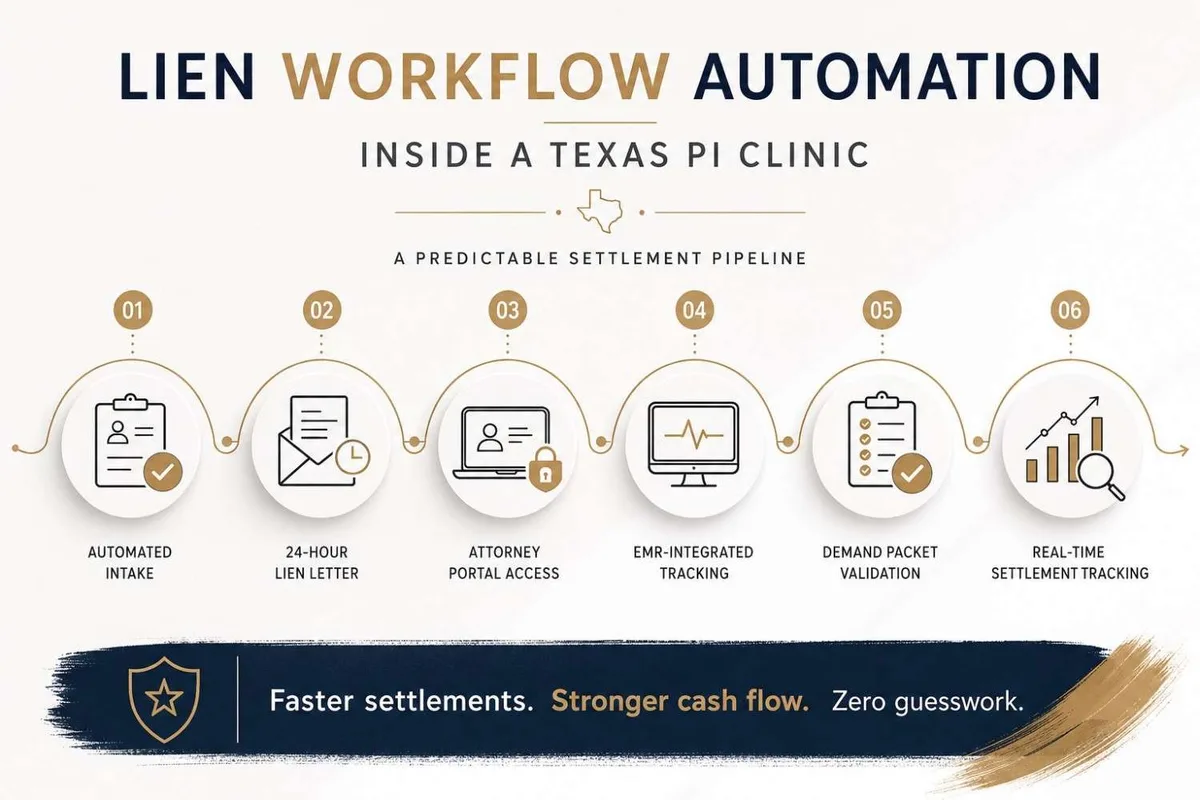
Instead of reacting to delays case by case, the clinic operates on a predictable settlement pipeline. Here is exactly what that looks like step by step inside a Texas PI clinic running InjuryDesk.
Step 1 — Automated Intake (94% Automation Rate)
The moment a PI patient is registered, a case file is created automatically and the LOP is tagged to the case. InjuryDesk achieves a 94% intake automation rate — eliminating manual data entry errors and starting the revenue clock correctly from day one.
Step 2 — 24-Hour Lien Letter Generation
Within 24 hours of intake, a timestamped lien letter is automatically generated and sent. No staff intervention. No delays. The attorney receives formal notification immediately — and your clinic has a documented delivery record.
Step 3 — Attorney Portal Access
Attorneys log into a dedicated portal for all case documents — treatment notes, billing records, lien letters — any time, without contacting your staff. Everything is organized, accessible, and timestamped automatically.
Step 4 — EMR-Integrated Treatment Tracking
InjuryDesk integrates directly with AdvancedMD, ChiroTouch, and Jane App. Treatment data flows from your EMR into the lien workflow automatically — no duplicate entry, no manual reconciliation between systems.
Step 5 — Demand Packet Checklist Validation
Before any demand packet is submitted, InjuryDesk validates it against a complete documentation checklist. Missing items are flagged before submission — not after a settlement rejection. No incomplete packets leave your clinic.
Step 6 — Real-Time Settlement Tracking
Full visibility into every open case, every day. No spreadsheets. No "Did we send the lien letter on this?" moments. Your team sees exactly where each case stands and which files need immediate attention.
This is what a managed personal injury clinic revenue cycle in Texas looks like when the workflow is owned by a system, not a staff member juggling 40 other tasks.
How InjuryDesk Tracks Every Case From Intake to Settlement
InjuryDesk is not a task manager or a billing add-on. It is a full PI revenue cycle platform built specifically for LOP-based clinics — replacing the manual, error-prone lien workflow that causes cash flow delays in the first place.
Core platform capabilities:
- HIPAA-compliant case management built for PI clinic workflows — see our data security standards
- Direct EMR/EHR integration with AdvancedMD, ChiroTouch, and Jane App
- Automated lien letter generation with a guaranteed 24-hour turnaround from intake
- Dedicated attorney portal with full timestamped communication history
- Demand packet validation before every submission — zero incomplete packets
- 94% intake automation rate — eliminating manual data entry errors at scale
- Real-time case status tracking across every open PI file
At $500 per month, InjuryDesk pays for itself when it accelerates just one or two settlements. Most Texas clinics report two to three additional timely settlements almost immediately after implementation — converting chronic PI clinic cash flow problems into a predictable, managed revenue pipeline.
See InjuryDesk in action and explore how it maps directly to your clinic's open caseload and settlement workflow. You can also review InjuryDesk features and pricing before your first conversation.
InjuryDesk is part of Synectus's PULSE operating system — learn more about the full PULSE framework here (Blog 9 — coming soon).
For the broader picture of how Texas lien management automation works across different clinic types in our market, visit our Texas locations and services page.
Book a Free Workflow Audit for Your Texas PI Clinic
If your clinic feels busy but your cash flow doesn't reflect it, your lien workflow is where the problem lives — and it is almost always fixable within 30 days of implementing the right system.
In a free 30-minute audit, Synectus's Texas-based team will map your current lien workflow, identify exactly where cases are stalling, and show you the precise gap between your current settlement timeline and what's achievable with lien workflow automation for PI clinics.
We work with injury clinics in Houston, Laredo, and Beaumont. Same-day response. No obligation.
Most clinics discover delays they didn't even know existed — until they see their workflow mapped in front of them.
Book Your Free Workflow Audit →
Stop financing cases on your own cash flow. Get the system that owns the process — so your revenue finally matches your schedule. The solution to PI clinic cash flow problems Texas lien management can't fix itself — but a 30-minute call with Synectus can start the process today.
Related reading
Next step
See how Synectus closes the handoff after the lead arrives.
If this article describes the exact gap inside your clinic, go one layer deeper into the service stack or book a direct strategy call with Synectus.