
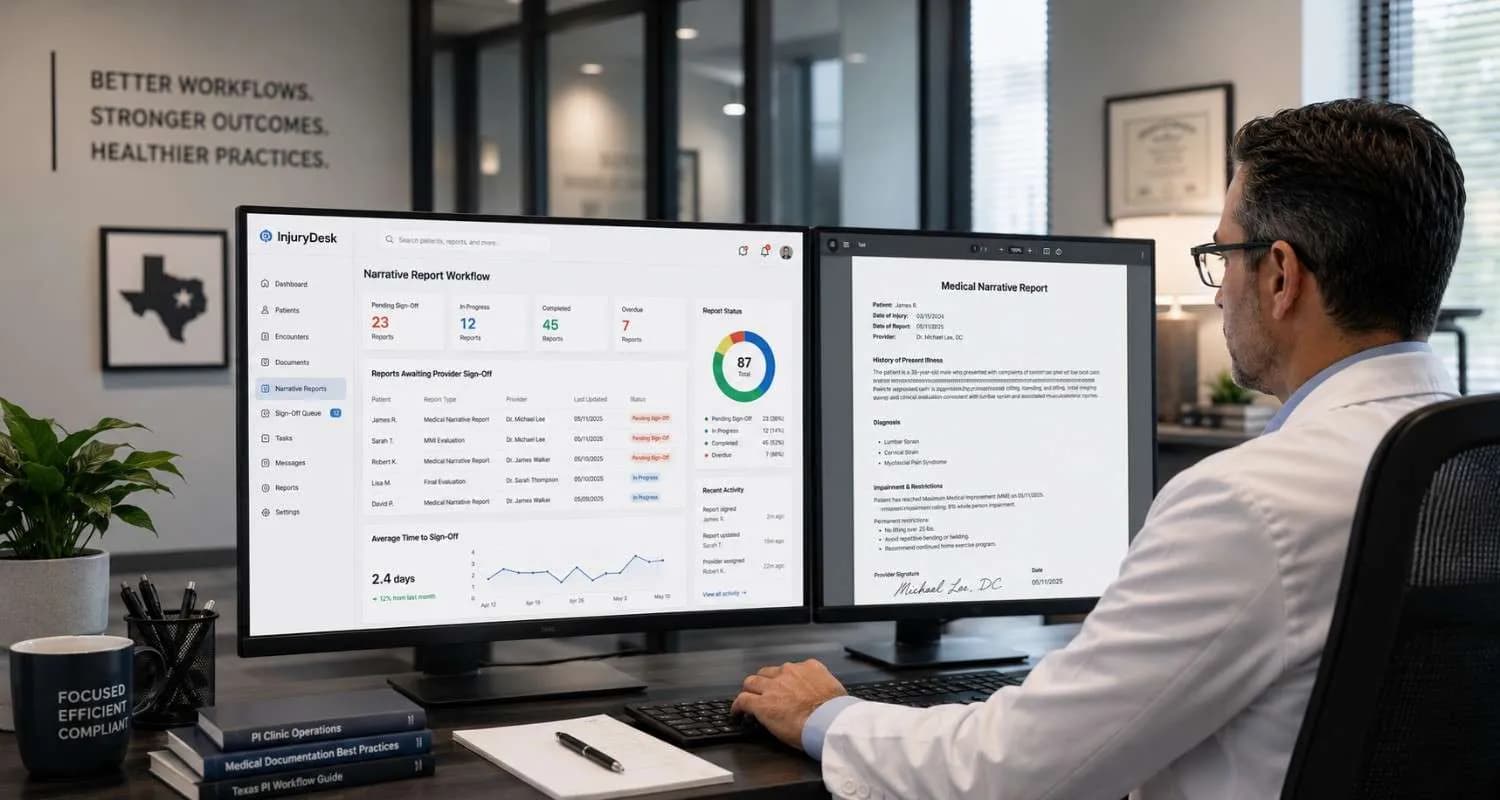
The patient has reached maximum medical improvement (MMI). The clinical work is flawless, and the final discharge visit is complete. Inside a Texas personal injury (PI) clinic operating on a Letter of Protection (LOP), the operational pipeline should smoothly transition to the billing and legal phase. But instead, a massive bottleneck occurs: the personal injury attorney cannot draft the demand letter because the final medical narrative report has not been written, signed, or submitted by the provider.
Medical narrative report delays Texas PI clinics face are rarely due to a lack of clinical expertise; they are a direct result of broken provider documentation workflows. When doctors, chiropractors, or specialists delay finishing charts or signing off on the final evaluations, the entire settlement timeline freezes.
In the highly competitive Texas PI market, attorneys measure clinic performance by operational velocity. If your providers consistently take two to three weeks to generate a final narrative report after the patient is discharged, those attorneys will route their next batch of high-value LOP cases to clinics with automated, high-speed documentation systems. This guide dissects the financial drain of provider documentation delays, their impact on attorney relationships, and the framework for automating narrative sign-offs.
Why Medical Narrative Report Delays Texas PI Clinics Face Create Settlement Bottlenecks
To fix the bottleneck, you must isolate the failure point. The issue is not the physical compilation of past records; it is the generation of the final, legally defensible narrative that ties the entire case together.
The legacy workflow that sabotages Texas PI clinics looks like this:
- Patient Reaches MMI: The final visit occurs, and the patient is discharged.
- The Queue Builds: The provider’s daily schedule is packed with active treatments, pushing documentation duties to the end of the day—or the end of the week.
- Provider Documentation Delay: The provider takes 7 to 14 days to write the final narrative report detailing permanent restrictions, impairment ratings, and causation.
- Narrative Delay: The back office cannot finalize the file because the most critical document lacks a signature.
- Demand Package Delay: The attorney's paralegal requests the file but is told it is "pending provider sign-off." The demand package cannot be sent to the insurance adjuster.
- Settlement Delay: The entire case is stalled. By the time the narrative is submitted, the adjuster uses the delay to argue the case lost momentum, leading to aggressive reduction demands.
This chain reaction is a structural failure that creates a cascade of negative financial consequences for both the clinic and the law firm.
The Financial Impact: Quantifying the Cost of Narrative Delays
Operating on a proper LOP workflow means you are acting as the bank. You are fronting the cost of care with the expectation of a payout upon settlement. When providers delay documentation, they are actively restricting your working capital.
1. The Time Value of Money
If it takes your providers 14 to 21 days to complete a narrative report, you have pushed your clinic's payday back by nearly a month. Multiply that delay across 100 open LOP cases, and hundreds of thousands of dollars in revenue remain artificially locked in the "pending documentation" phase.
2. Settlement Devaluation and Reduction Demands
Insurance adjusters use time and momentum as weapons. When a demand package is delayed because the clinic could not produce a timely narrative, the attorney faces immense pressure from their client to settle quickly once the file is finally ready. If your clinic was the bottleneck, you lose all leverage during settlement negotiations. The attorney will look at your billed ledger and demand steep reductions (often up to 50%) to compensate for the friction and get the case closed.
3. The Paralegal's Perspective: The Death of Referral Pipelines
PI attorneys rely heavily on their paralegals to move cases forward. Paralegals track operational velocity meticulously. If a paralegal has to call your clinic three times just to get a doctor to sign an MMI evaluation, you are actively burning bridges. The attorney will quietly route their next batch of real-time LOP cases to a competitor whose providers complete documentation within 24 hours.
Texas HIPAA Compliance and Legal Portal Security
Texas maintains stringent data privacy laws, particularly the Texas Medical Records Privacy Act (Texas HB 300), which expands upon federal HIPAA regulations. When narratives are finally completed, sending unencrypted PDFs via standard email or relying on outdated fax machines is a massive liability.
Modern clinics utilize secure, role-based access. Once the provider signs the narrative report, it should instantly and securely populate into a compliant legal portal. Rather than "pushing" documents to the law firm, advanced clinics allow the law firm to "pull" the completed narrative and associated ledgers via a secure login. This eliminates data breaches caused by misdirected emails and provides an auditable trail of exactly when the narrative was finalized and accessed.
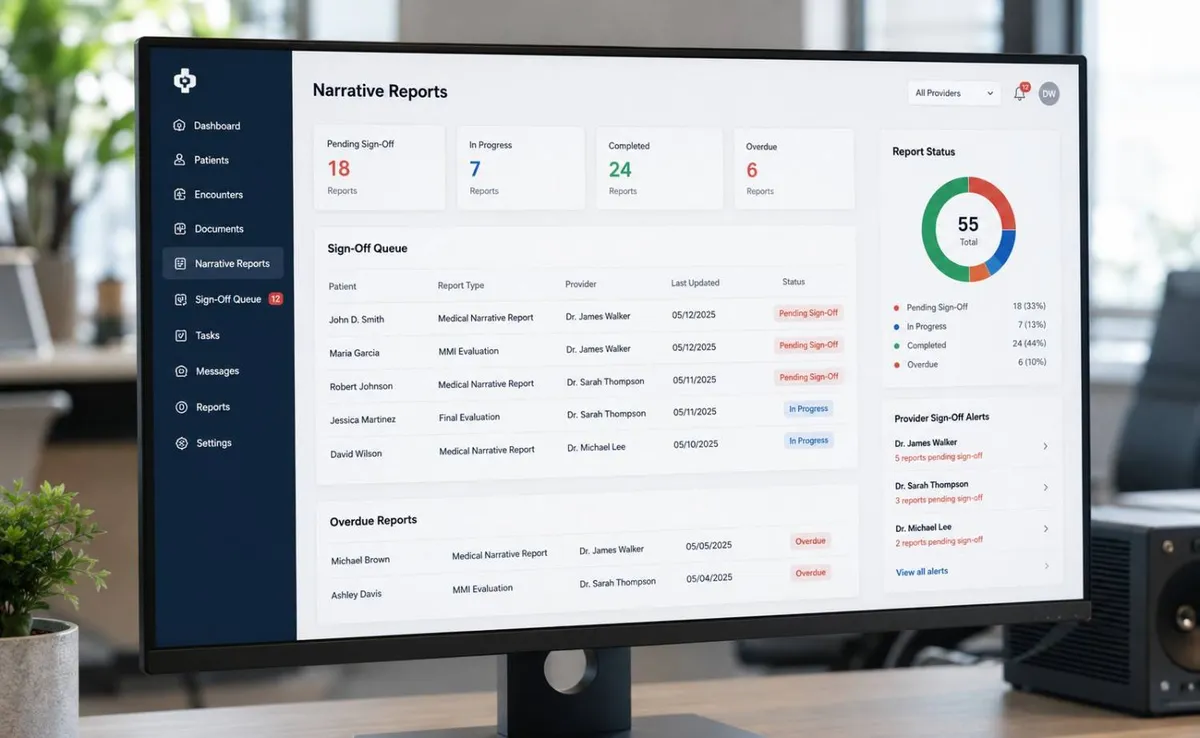
Manual Workflows vs. Automated Provider Documentation
Let’s look at the hard numbers between relying on manual provider memory versus utilizing an automated infrastructure that forces documentation compliance.
Metric | Legacy Manual Workflow | Automated Narrative Workflow via InjuryDesk |
|---|---|---|
Narrative Completion Time | 7 to 21 Days post-MMI | 24 to 48 Hours |
Provider Task Tracking | Sticky notes, emails, memory | Automated digital queues & hard stops |
File Completeness | High risk of missing signatures | 100% compliance before portal release |
Delivery Method | Fax / Encrypted Email Zip Files | Instant Role-Based Legal Portal Login |
Attorney Satisfaction | Low (Creates high operational friction) | Extremely High (Drives repeat referrals) |
The cost of a paralegal waiting three weeks for a signature far exceeds the investment in software that standardizes and enforces provider documentation timelines.
Step-by-Step Implementation of an Automated System
To dominate the Texas personal injury market, your clinic must transition to a proactive documentation model that holds providers accountable without adding administrative bloat.
Step 1: Implement Hard Stops in the EHR
Providers should not be able to close a patient's final visit without generating the baseline narrative report. Implement software hard stops that require essential fields (causation, impairment rating, future care needs) to be filled before the daily chart can be locked.
Step 2: Deploy Automated Sign-Off Queues
Instead of back-office staff chasing doctors for signatures, providers need a centralized, digital dashboard that clearly flags pending narrative reports. This queue must be visible to clinic management to track which providers are causing bottlenecks.
Step 3: Automated Attorney Portal Access
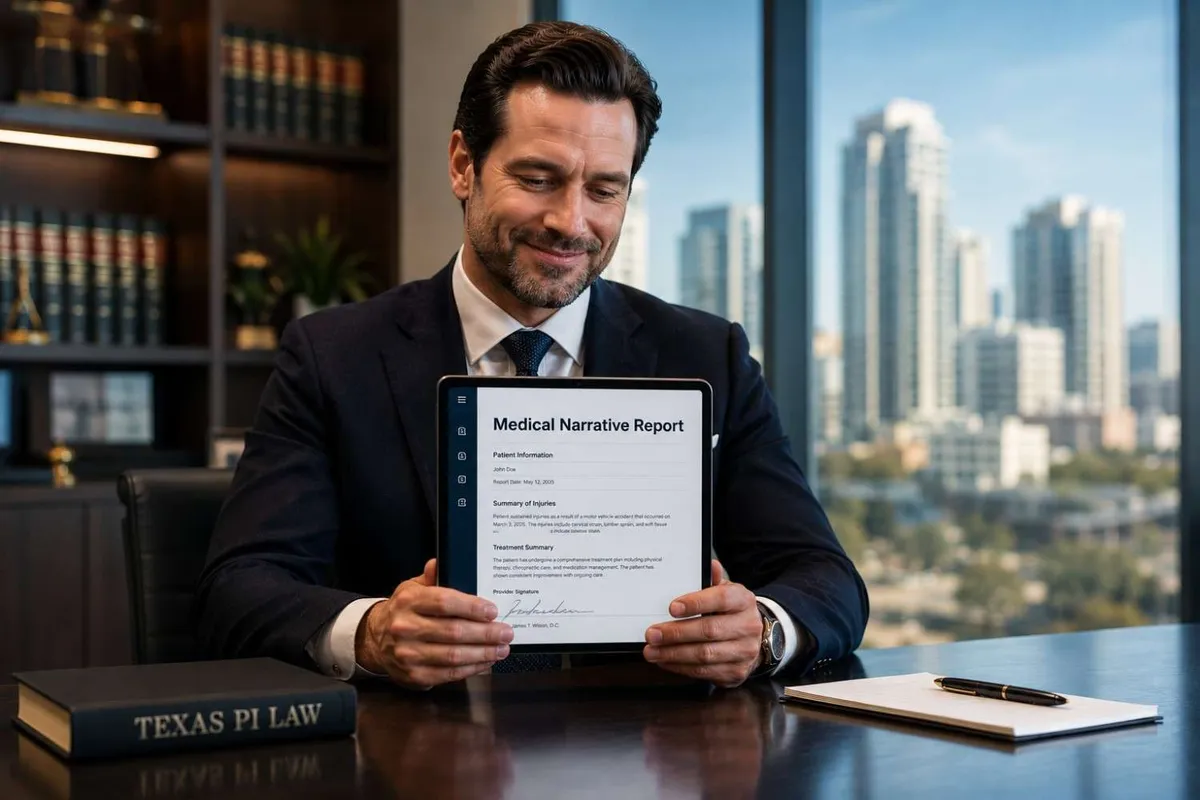
Once the provider applies their digital signature, the system must instantly compile the narrative with the corresponding clinical notes and HCFA-1500 forms. The system should then automatically alert the connected attorney that the complete, legally defensible file is ready in their secure portal.
How InjuryDesk Eliminates Narrative Bottlenecks
This is exactly why Synectus developed InjuryDesk™. We recognized that clinics were losing millions in delayed cash flow simply because provider documentation was not integrated into the legal workflow.
InjuryDesk actively monitors the patient’s lifecycle. It forces clinical compliance, ensuring providers are immediately alerted when a narrative report is due. Once the provider signs off, InjuryDesk compiles the clinical notes, the itemized billing, and the final narrative into a pristine, adjuster-ready package. It then alerts the connected attorney that the file is ready in their secure portal, completely eliminating the delay between MMI and the demand package.
Conclusion
For a personal injury clinic in Texas, generating a timely medical narrative report is a critical revenue cycle event. Provider documentation delays silently kill your cash flow and destroy attorney trust. By enforcing strict documentation timelines, automating sign-off queues, and leveraging purpose-built technology like InjuryDesk, Texas PI clinics can eliminate the bottlenecks that stall settlements and position themselves as top-tier partners for high-volume law firms.
Related reading
Next step
See how Synectus closes the handoff after the lead arrives.
If this article describes the exact gap inside your clinic, go one layer deeper into the service stack or book a direct strategy call with Synectus.