
AI scribes for PI clinics are reducing after-hours charting by up to 70% — and in Texas personal injury practices, where documentation accuracy directly affects lien settlement outcomes, that efficiency gain translates into both operational relief and measurable revenue recovery.
If your providers are spending two or more hours daily finishing charts after patients leave, you are not running an inefficiency problem. You are running a staffing problem disguised as a documentation problem. AI scribes address the root cause.
The Documentation Crisis Hitting Texas PI Clinics Harder Than Most
Texas personal injury clinics operate under documentation pressure that general medical practices simply do not face. Every clinical note is a potential exhibit. Every missed detail in a SOAP entry — a symptom not recorded, a mechanism of injury described vaguely, a treatment rationale left implicit — can reduce a settlement offer or invite a records dispute months after the patient has been discharged.
The Texas Medical Association reports that 63% of physicians spend more than two hours daily on documentation outside of patient care time. In a PI clinic context, that two-hour figure is not just a burnout statistic. It is two hours of after-hours charting that your attorneys are waiting on, two hours of delay before demand letter preparation can begin, and two hours of provider attention that was not spent on the next patient.
Texas telehealth volume doubled during the early pandemic period and has held 85% of that increase through 2026, according to healthcare telehealth utilization data published by the Texas Medical Association and federal healthcare reporting trends. PI clinics that added telehealth follow-up appointments during that period discovered quickly that documentation workflows built for in-person visits do not translate. AI scribes emerged as the practical solution — not as a novelty, but as infrastructure.
The core problem is structural. PI clinics typically see high patient volumes on letter of protection (LOP) arrangements, which means documentation must be thorough enough to support future lien negotiations with insurance carriers. A provider rushing through charts at 8pm is not producing the same quality of clinical narrative as a provider who documented in real time during the encounter. AI scribes close that gap.
What AI Scribes for PI Clinics Actually Do Inside a Patient Encounter
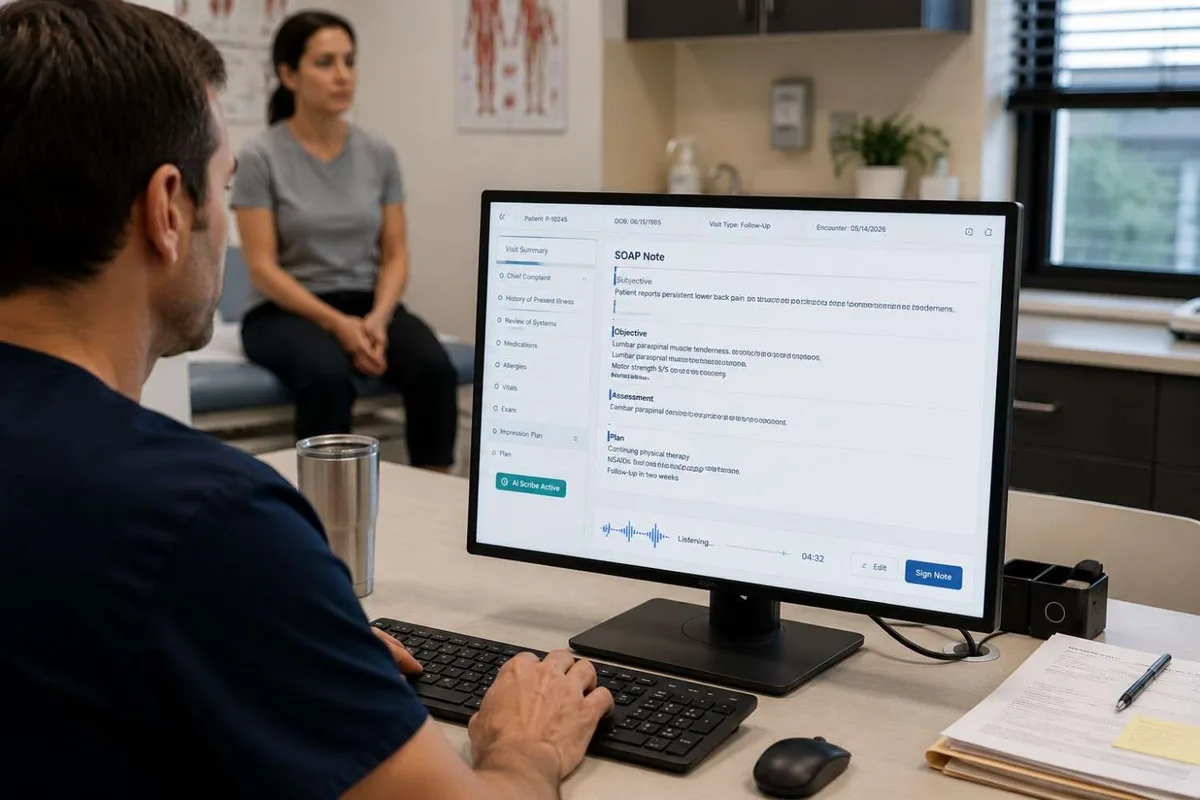
The term "AI scribe" covers a range of tools, but the operational model is consistent: the system listens to the clinical conversation during the encounter, processes the speech in real time or near-real time, and generates a structured clinical note — typically in SOAP format — without the provider typing a word.
A large multisite study published in JAMA in April 2026, conducted across five academic medical centers with 1,800 clinicians from 2023 to 2025, found that ambient AI scribes reduced total EHR time by 13.4 minutes and documentation time by 16 minutes per encounter. Clinicians using AI scribes were able to see one additional patient every two weeks — a modest but statistically meaningful capacity gain.
In a controlled lab setting, AI scribes were associated with a 69.5% reduction in time spent documenting during clinical encounters (p<0.001). In routine practice, primary care physicians reported a three-hour reduction per week in after-hours administrative tasks (p<0.05), according to the OntarioMD AI Scribe Evaluation Final Report.
For PI clinics specifically, the workflow looks like this:
- Patient arrives for a follow-up after a motor vehicle accident. The provider activates the AI scribe at the start of the encounter.
- The provider conducts the visit normally — asking about symptom progression, reviewing imaging findings, performing a physical examination, and discussing the treatment plan.
- The AI scribe captures the conversation, identifies clinical entities (chief complaint, history of present illness, review of systems, examination findings, assessment, plan), and structures them into a draft SOAP note.
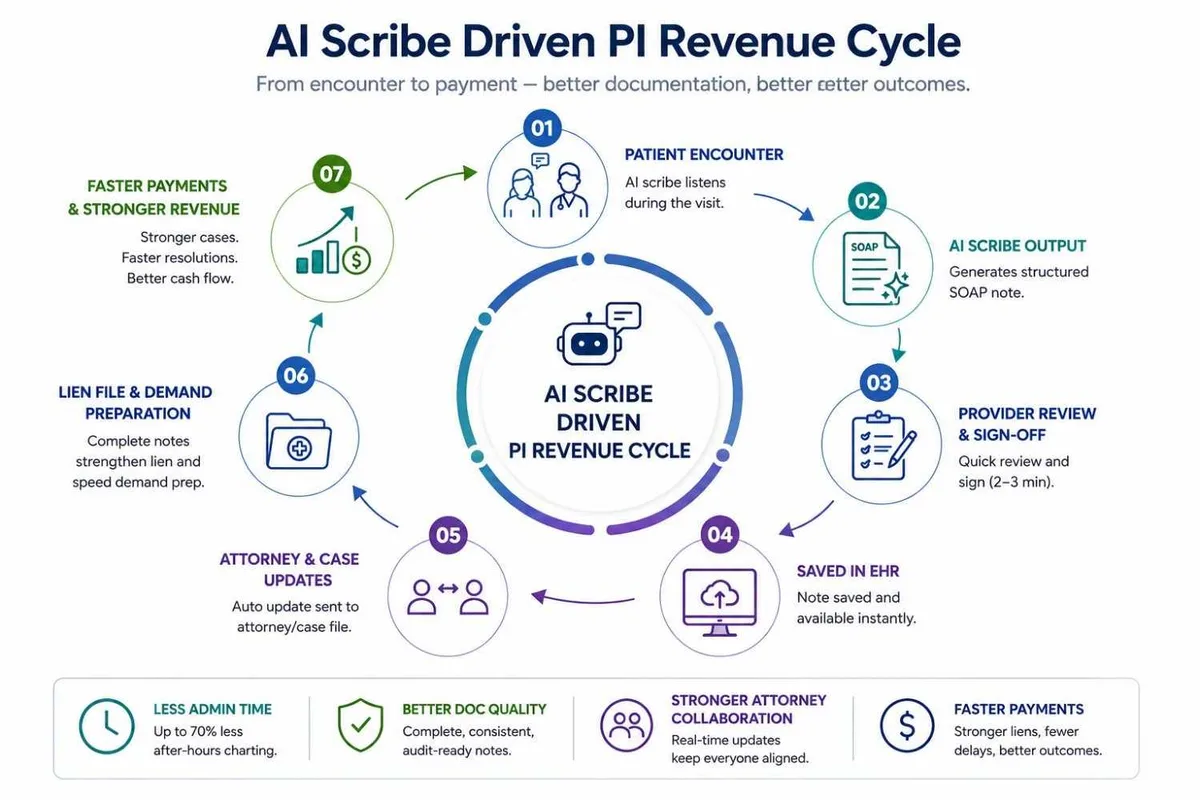
- The provider reviews the draft, makes minor edits if needed, and signs off — typically within two to three minutes.
- The completed note is available immediately for attorney review, lien file updates, or demand letter preparation.
That last step matters enormously in PI operations. When attorney-clinic communication tools are integrated with your documentation workflow, a signed note can trigger automatic updates to the case file and notify the referring attorney — without a staff member making a phone call or sending a manual email.
Implementation Considerations for Texas PI Clinics
Adopting AI scribes is not a plug-and-play decision. There are four areas Texas PI clinic operators need to evaluate before selecting a tool.
1. EHR Integration and Data Flow
The AI scribe must connect to your existing EHR system. A scribe that generates notes in a separate interface — requiring copy-paste into your EHR — defeats much of the efficiency gain and introduces transcription error risk. Evaluate whether the tool offers native EHR integration or whether API connectivity solutions are needed to bridge the gap between the scribe platform and your practice management system.
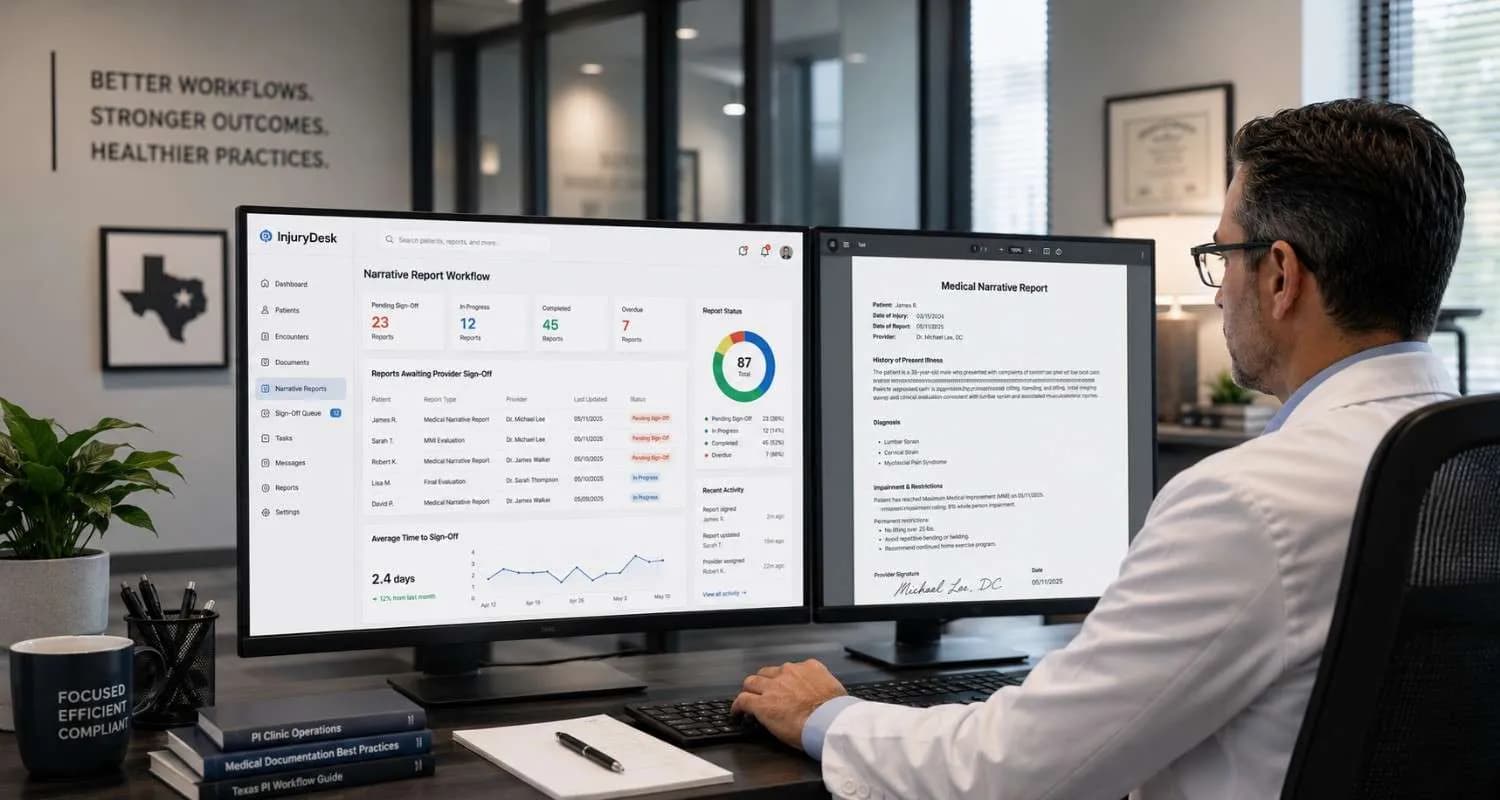
PI-specific practice management platforms, including InjuryDesk, are designed to handle LOP workflows, lien tracking, and attorney communication alongside clinical documentation. An AI scribe that feeds directly into that environment — rather than into a generic EHR — produces notes that are immediately usable in the legal workflow, not just the clinical one.
2. HIPAA Compliance and Data Storage
Every AI scribe vendor that processes patient audio must be evaluated for HIPAA compliance. Specifically, Texas PI clinic operators should confirm:
- Whether the vendor signs a Business Associate Agreement (BAA)
- Where audio recordings are stored and for how long
- Whether the system uses de-identified or identified data for model training
- Whether patient consent is required before recording, and how that consent is documented
Texas follows federal HIPAA standards, but some vendors have additional state-specific data handling requirements. Do not assume HIPAA compliance from marketing materials — request the BAA and review the data processing agreement before signing any contract.
3. PI-Specific Documentation Requirements
General-purpose AI scribes are trained on broad clinical language. PI documentation has specific requirements that generic models may handle inconsistently:
- Mechanism of injury language must be precise — "patient reports rear-end collision at approximately 35 mph" versus a vague "patient involved in accident"
- Causation language matters for lien cases — the note must connect the presenting condition to the documented injury event
- Functional limitation documentation supports the attorney's demand narrative and must be captured consistently across every visit
Some AI scribe platforms allow custom templates and terminology libraries. For PI clinics, building a PI-specific template — or working with a vendor that has PI clinic experience — is worth the setup investment.
4. Provider Adoption and Workflow Discipline
As one analysis from DoraScribe notes: "AI scribes are not magic. They are workflow multipliers. In workflows that are already disciplined, they can save significant time."
Providers who speak clearly during encounters, complete their physical examination before discussing the plan, and follow a consistent visit structure will see the strongest results. Providers who conduct fragmented, interrupted visits — common in high-volume PI clinics — may need workflow coaching before AI scribe adoption produces reliable output.
Physical therapy clinics that have adopted AI scribes report a 50% cut in documentation time, more than 20 hours saved weekly, and approximately $30,000 in annual revenue recovered through improved capacity,according to operational efficiency findings published in healthcare workflow and clinical documentation studies. PI clinics with PT services can apply the same model.
Connecting AI Scribe Output to the PI Revenue Cycle
Documentation quality in a PI clinic is not just a clinical concern — it is a revenue cycle input. Here is how AI scribe output connects to downstream financial outcomes:
Lien file accuracy. When notes are complete, timely, and consistently structured, the lien file is stronger. Attorneys working on LOP cases can build demand packages faster when clinical records are clear and causation language is explicit.
Demand letter preparation. Demand letter automation tools that draw from clinical documentation depend on that documentation being structured and complete. AI scribes that produce consistent SOAP notes make automated demand letter generation more accurate and reduce the manual review burden on your billing and legal liaison staff.
Audit and dispute response. When an insurance carrier disputes a lien, your clinic's ability to respond quickly with complete, well-structured records is a direct function of documentation quality. AI-generated notes that are reviewed and signed by the provider carry the same legal weight as manually typed notes — and they are often more complete because the system captures the full conversation rather than a provider's hurried summary.
Patient data continuity. For clinics using custom CRM systems to track patient case status, AI scribe output that integrates with the CRM ensures that clinical progress is visible alongside case milestones — attorney communication logs, lien status, appointment history — in a single view.
What Realistic Outcomes Look Like
It is worth being precise about expectations. The JAMA 2026 study found 16 minutes saved per encounter — not hours per day. At 20 patient encounters daily, that is roughly five hours of documentation time recovered across the provider team. Combined with the three-hour weekly reduction in after-hours charting reported in the OntarioMD evaluation, the aggregate impact across a mid-size PI clinic is meaningful.
One Texas family physician described the shift this way: "I used to spend three hours a day catching up on charts. With AI scribing, my evenings are mine again." That outcome reflects a clinic that had already standardised its intake and visit workflows — the AI scribe amplified an existing operational discipline rather than compensating for chaos.
The STAT News analysis of the same JAMA study noted that the capacity gain of one additional patient every two weeks is modest in isolation, but compounded across a full provider team over a year, it represents a measurable revenue increase — without adding staff or extending hours.
Related reading
Next step
See how Synectus closes the handoff after the lead arrives.
If this article describes the exact gap inside your clinic, go one layer deeper into the service stack or book a direct strategy call with Synectus.