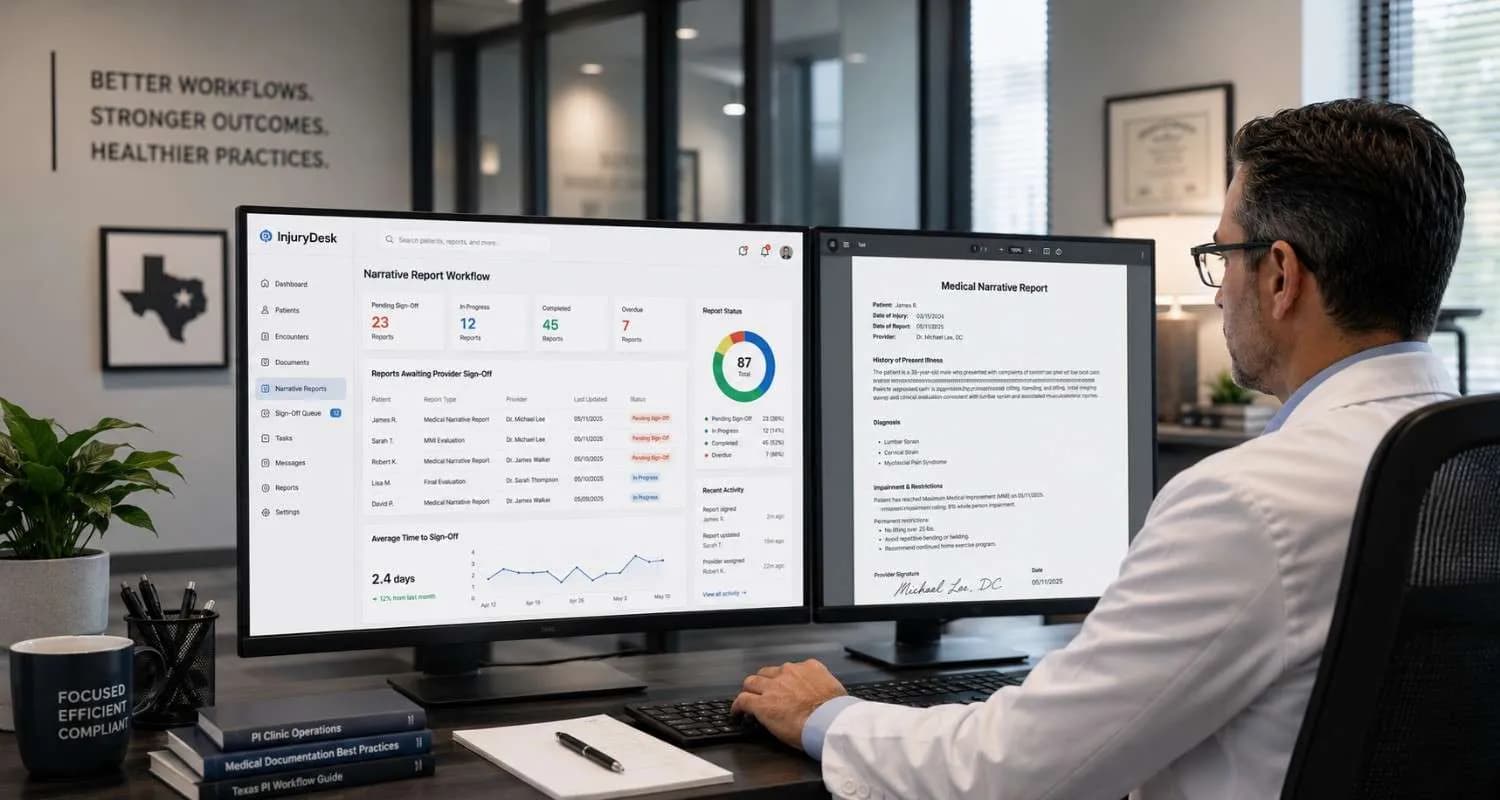

Most Texas PI clinics don't fail because of bad marketing or poor patient care. They fail because their operations were never built to scale. If you've doubled your patient volume in the last 12 months and your staff is more overwhelmed than ever — this article is exactly what you needed six months ago.
PI clinic operations Texas owners know this breaking point well: the caseload grows, but the systems don't. LOP documentation slips. Attorney follow-ups pile up. Billing lags behind treatment cycles. What once felt like a busy clinic starts feeling unmanageable.
The difference between a clinic stuck in that chaos and one scaling profitably is not effort — it's infrastructure. Here are the 6 operational systems every profitable Texas PI clinic has in place, and how InjuryDesk™ PI clinic management software ties all six into one scalable platform built for PI environments.
Why PI Clinic Operations Texas Break Down Before They Scale
The pattern is almost identical across every Texas PI clinic that hits an operational ceiling. It rarely starts as a crisis — it starts as small cracks: one missed LOP record, one unreturned attorney call, one incomplete intake form. Then those cracks multiply until the revenue impact becomes impossible to ignore.
Here is what that breakdown typically looks like across Texas PI clinics:
- Intake is inconsistent — no two staff members run the same workflow
- LOP documentation is scattered — missing lien records slow settlements for months
- Attorney communication breaks down — follow-ups fall through with no centralised tracking
- Billing is delayed — staff too overwhelmed to chase claims efficiently
- Multi-location clinics have zero consistency — each site runs differently, making oversight impossible
The most profitable PI clinic operations Texas model replaces that manual chaos with structured, role-based workflows. Here is exactly what those six systems look like.
System 1 — Patient Intake & First Appointment Workflow
The intake process is where PI clinics either convert patients or lose them. A disorganised workflow doesn't just frustrate patients — it creates documentation gaps that haunt your LOP cases months later during settlement negotiations.
Profitable Texas PI clinics standardise intake so every staff member follows the same process: digital forms at first contact, immediate LOP status verification, automated appointment scheduling, and clear role-based documentation. For multi-location clinics, this consistency is non-negotiable.
InjuryDesk builds intake tracking directly into the patient intake system, ensuring every patient follows the same pipeline regardless of location. Combined with appointment scheduling workflows, your conversion rate becomes measurable and improvable. But intake efficiency is only half the equation — the real test begins the moment an LOP case is opened.
System 2 — Lien Documentation & Attorney Communication
This is the system that separates profitable PI clinic operations Texas clinics from struggling ones. LOP cases hinge on documentation precision. One missing lien update, one unreturned call — and a case that should settle in 90 days drags on for 12 months, tying up revenue and straining attorney relationships.
Profitable Texas PI clinics maintain centralized lien tracking, timestamped attorney communication logs, and automated case status visibility — so attorneys never need to call your staff for updates. The breakdown between clinics and attorneys isn't a relationship problem — it's a systems problem.
InjuryDesk™'s LOP management system and dedicated attorney-clinic communication portal centralise every interaction, making lien management software a direct revenue protection tool — not an administrative afterthought. Once lien documentation is secure, the next revenue risk is treatment gaps.
System 3 — Treatment Scheduling & Follow-Up Tracking
In personal injury care, treatment gaps don't just affect patient outcomes — they create documentation vulnerabilities that attorneys and insurers exploit. A missed appointment not rescheduled within 24 hours can undermine an entire case value.
Profitable Texas PI clinics build automated follow-up systems that flag missed appointments in real time, trigger rescheduling without staff intervention, and track treatment progression against care plans. When follow-up runs automatically through your PI clinic management systems, your front desk focuses on higher-value work instead of two hours of daily reminder calls.
InjuryDesk™ integrates scheduling automation with treatment tracking across every active case. Paired with a virtual assistant workflow, your clinic handles higher patient volumes without proportionally increasing headcount. With treatment continuity protected, the next hidden cost is records delays.
System 4 — Medical Records & Imaging Management

Delayed medical records are one of the most expensive and least visible problems in PI clinic workflow automation. Every delayed record extends a settlement timeline — and stretches cash flow further out.
Clinics managing records manually aren't just wasting staff time — they're bleeding revenue. As the Medical Group Management Association (MGMA) consistently identifies, administrative inefficiency is a leading driver of revenue leakage in specialty practices, hitting PI clinics hardest because every delayed record directly extends a settlement timeline.
InjuryDesk™'s medical records management module and legal medical records workflow replace reactive record-chasing with a proactive centralized system that keeps settlements on track automatically. Strong records management protects timelines — but protecting collected revenue requires an equally disciplined billing system.
System 5 — Billing, Collections & LOP Case Tracking
Revenue doesn't happen when you treat a patient — it happens when your billing system captures, submits, and follows through on every claim consistently. Most billing delays don't originate with insurers — they originate from incomplete clinic-side submissions. The Texas Department of Insurance consistently reports provider-side submission errors as a leading cause of prolonged claim processing.
This is where LOP case tracking becomes a direct revenue tool. Real-time visibility into lien balances, case ages, and settlement status structurally improves collection rates and reduces write-offs.
InjuryDesk™ integrates medical billing and coding, insurance verification, and case status tracking into one unified revenue view — so billing and clinical teams always work from the same data, not parallel spreadsheets.
System 6 — Reporting & Clinic Performance Metrics
You cannot manage what you cannot see. Most Texas PI clinic owners make operational decisions based on gut feel and month-end summaries — a growth ceiling disguised as a management style. Practices that invest in data-driven management significantly outperform those that don't, as the American Chiropractic Association highlights across specialty practice benchmarks.
Profitable PI clinics track intake-to-treatment conversion rates, attorney referral performance by source, LOP case aging, and per-location benchmarks — weekly, not monthly.
InjuryDesk™'s real-time dashboards, combined with custom CRM capabilities and API integration, give clinic owners the visibility to make confident, forward-looking decisions — without waiting 30 days to discover what went wrong.
How InjuryDesk™ Automates All 6 Systems in One Platform
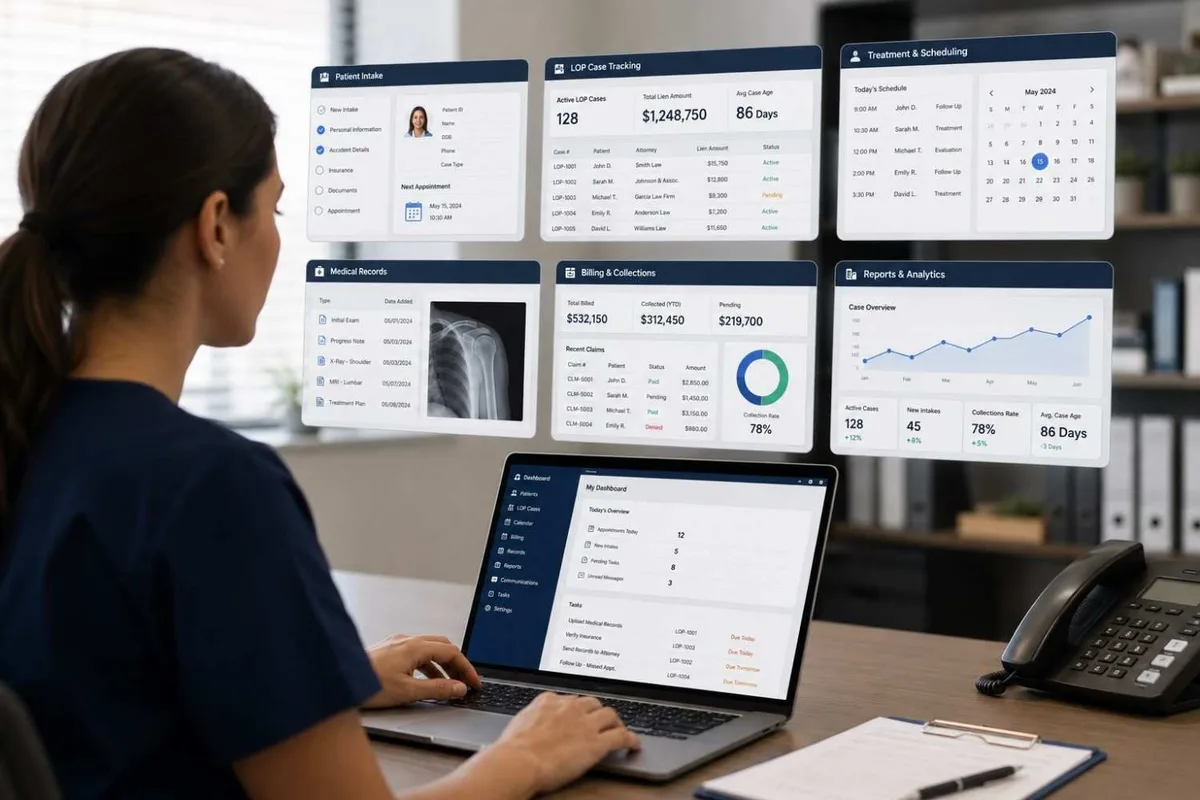
Most Texas PI clinics aren't failing because of effort — they're failing because they're running six functions across six disconnected tools with no integration and no shared visibility. Every handoff between systems is a failure point, and in a PI clinic environment, failure points cost real money.
InjuryDesk™ was built specifically for personal injury clinic operations. What makes it different from generic PI clinic management systems is that every workflow was designed around the specific constraints of PI environments: LOP timelines, attorney referral relationships, multi-provider records coordination, and settlement-driven billing cycles. No retrofitting. No workarounds.
The PULSE Method™ — The Operational Framework Behind InjuryDesk™
InjuryDesk™ runs on Synectus's proprietary PULSE Method™ — a framework built through real-world PI clinic deployments:
P — Pipeline :
Every patient and case moves through a defined, trackable pipeline from first contact to settlement
U — Usher:
Cases move forward through automated triggers — not staff memory or manual follow-up
L — Look After:
Active cases are continuously monitored, with alerts for any deviation from expected timelines
S — Support:
Clinical staff, billing teams, and attorneys work from one centralised data layer — eliminating back-and-forth
E — Execute:
Clinic leadership executes confident decisions backed by real-time performance data, not lagging indicators
This is a complete operational model for running profitable PI clinic operations Texas environments — reproducible, scalable, and audit-ready.
What Profitable Texas PI Clinics Do Differently
The gap between a clinic doing $800K and one doing $3M is rarely patient volume or clinical quality. It's whether the clinic runs on documented, auditable systems — or on whoever happens to be on shift that morning. And given that the Texas Medical Board has progressively tightened documentation standards for PI-adjacent practices, operational defensibility is no longer optional.
Profitable Texas PI clinics share the same operational DNA: system-driven intake, centralised lien management, automated follow-up, real-time billing visibility, structured attorney portals, and performance dashboards — replacing manual chaos with infrastructure that holds up under volume, staff turnover, and regulatory scrutiny.
These aren't aspirational targets. They're the baseline that separates clinics that scale from clinics that stall.
Book Your Free PI Clinic Operations Strategy Call
If your clinic is managing growing patient volume but operations are still held together by spreadsheets and staff heroics — it's time to build the infrastructure that profitable Texas PI clinics actually run on.
Synectus has built and deployed these exact six systems for PI clinics across Texas — from single-location startups to multi-site operations managing hundreds of active LOP cases monthly. We've fixed these operational gaps across dozens of clinics that looked exactly like yours.
Book your free PI clinic strategy call — and take the first step toward a clinic that runs on systems, not stress.
Want to see InjuryDesk™ first? Request your InjuryDesk™ demo and see all 6 systems working together in one purpose-built platform.
Related reading
Next step
See how Synectus closes the handoff after the lead arrives.
If this article describes the exact gap inside your clinic, go one layer deeper into the service stack or book a direct strategy call with Synectus.