
Introduction
Most Texas PI clinics don't have a referral network. They have 3 relationships — and they call it a network.
A Houston clinic owner discovered this the hard way. His top two referring attorneys retired in the same calendar year. Within 90 days, his appointment schedule dropped by over 60%. The staff sat idle. Payroll became painful. Panic followed. The clinic had no Google presence, no second referral tier, no structured patient intake system — nothing to catch the fall.
This is the hidden flaw in most attorney referral network Texas PI clinic growth strategies: they aren't networks at all. They're concentrated dependencies dressed up as stability. And the worst part? You won't see the risk coming — until it hits you all at once.
If your top 2–3 attorneys represent the majority of your patient volume, this article is written directly for you.
The Referral Dependency Trap Most Texas PI Clinics Don't See Coming
Here is the number most clinic owners don't want to calculate: What percentage of your monthly patient volume comes from your top 3 referring attorneys?
For the majority of Texas PI clinics, that number sits between 70% and 85%.
That's not a referral network. That's a single point of failure — multiplied by three.
The problem isn't that you have strong attorney relationships. Strong relationships are an asset. The problem is when those relationships are the only asset holding your pipeline together. Attorney clinic referral dependency masquerades as security. Month after month, cases arrive, revenue flows, and you assume the system is working. It is working — until it isn't.
Consider the math of attorney career timelines. According to American Bar Association lawyer demographic data, the average attorney practices for 20 to 25 years before retirement or transition. If your top referring attorney is currently 52 or older, their retirement window is already open. You may have 3 years. You may have 18 months. You may already be in your last year of their referrals — and you have no way of knowing.
Without a deliberate personal injury clinic referral strategy, your entire revenue model rests on a timeline you don't control. This is the core vulnerability inside every attorney referral network Texas PI clinic growth plan that relies on relationship depth without relationship diversity: if one attorney controls your pipeline, you don't own your growth — they do.
Clinics don't fail because referrals stop. They fail because they never built the infrastructure to survive when referrals stop. The dependency was always there — it just hadn't been tested yet.
What Happens When Your Top Attorney Retires — A Houston PI Clinic Story
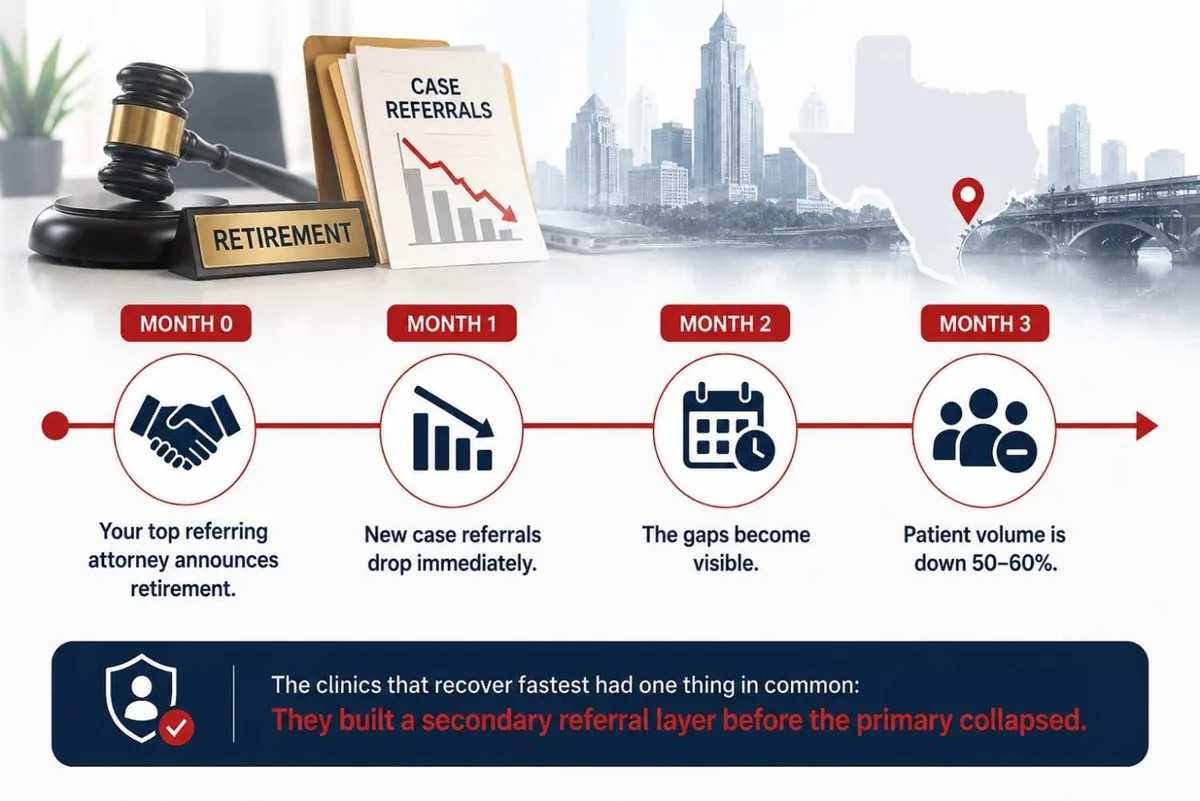
The timeline is predictable. It's the same across Houston, Beaumont, and Laredo. And it moves faster than most clinic owners expect.
Month 0 :
Your top referring attorney announces retirement at an industry event. You congratulate them. You don't immediately act.
Month 1 :
New case referrals from that attorney drop immediately. They're winding down their caseload. The first scheduling gaps appear.
Month 2 :
The gaps become visible. Staff hours look different. You start calling other attorneys — ones you've never actively nurtured — and realize relationships that aren't warm don't convert quickly.
Month 3 :
Patient volume is down 50–60%. Your second top referrer — sensing your clinic's instability — quietly begins diversifying where they send cases. You're no longer the default.
What makes this worse in Texas is the regional dynamic. According to TxDOT crash report data, Texas records among the highest motor vehicle crash volumes in the country — meaning PI patient demand is not the problem. The problem is clinic-side referral infrastructure. In Houston, the PI clinic market is highly competitive. Attorney referrals redistribute quickly — to clinics that have already built second-tier relationships. In Beaumont, the referral network is smaller and more tightly relationship-driven, meaning losing one key attorney has an amplified impact with fewer replacements available. In Laredo, attorney-clinic relationships are built on trust over years — you cannot fast-track them when you're already in crisis.
The clinics that recover fastest have one thing in common: they had already built a secondary referral layer before the primary one collapsed. Recovery from a 50–60% volume drop takes a minimum of 4 to 6 months — and some clinics never return to their previous capacity.
You don't experience referral loss gradually. You experience it all at once.
The 3 Referral Channels Texas PI Clinics Ignore Until It's Too Late
The strongest attorney referral network Texas PI clinic growth systems don't rely on one channel. They activate at least three simultaneously. Here's where most Texas PI clinics are leaving their pipeline dangerously exposed:
1. Tier 2 Attorneys — The Missed Layer
Every major Texas PI market has a second tier of attorneys: smaller firms, solo practitioners, and mid-size offices handling overflow cases, niche injury types, and geographic specialties. These attorneys consistently refer 2–5 cases per month — rarely enough to anchor a pipeline alone, but collectively enough to replace your most concentrated referral dependency.
Most clinic owners have never called these attorneys. Their competitors have.
Your competitors aren't waiting for your top attorney to retire — they're quietly building the replacement pipeline in your own market, right now.
Tier 2 attorney relationships are built through direct outreach, consistent follow-up, and case outcome communication. Effective personal injury patient referral management at this tier means treating smaller firms with the same strategic attention you give your top referrers. It takes time — which is exactly why you cannot start building these relationships after your primary referrer retires.
2. Google Local Search — Patients Who Choose You Before Calling Any Attorney
This is the channel most Texas PI clinic owners underestimate until they see the data: a measurable percentage of personal injury patients search for a clinic before they ever contact an attorney.
Search queries like "car accident chiropractor near me," "injury clinic after accident Houston," or "neck pain after car wreck Beaumont" represent patients in the decision window — and the clinic that appears at the top of local search captures that patient without any attorney involvement at all. Google's local search ranking guidelines confirm that proximity, relevance, and profile completeness are the top factors — all of which are within your clinic's direct control.
This is not traditional marketing. This is PI clinic patient acquisition Texas at its most direct — patient interception before referral dependency begins.
For a deeper look at how PI clinics build consistent organic patient flow, read: How PI Clinics Generate Consistent Patient Flow Online — the strategies covered there work in parallel with your attorney referral ecosystem. You can also explore Synectus's dedicated local SEO services for PI clinics to see exactly how this channel is activated.
3. Community and Employer Referral Pipelines
Texas has unique industry corridors that most PI clinics never tap into as formal referral sources.
In Houston's oil and gas sectors, workplace injuries create a consistent pipeline of patients who need treatment regardless of attorney relationship. In Beaumont, logistics and warehouse corridors generate soft-tissue and repetitive injury cases. In Laredo, cross-border workforce dynamics create injury patterns that neither clinic owners nor attorneys have fully organized around.
Employer relationships, union case managers, and occupational health coordinators don't retire. They don't decide to stop referring. And they scale with effort — the more you invest in these relationships, the more consistent they become.
The most stable referral sources aren't the ones you rely on today — they're the ones you haven't built yet.
The Attorney Referral Network Texas PI Clinic Growth Strategy That No Single Retirement Can Break

Most agencies generate leads. Synectus restructures your entire referral ecosystem so that no single exit point can collapse your revenue. A true Texas PI clinic growth strategy doesn't patch one weak relationship — it rebuilds the architecture beneath your entire patient pipeline.
This is what a genuine attorney referral network Texas PI clinic growth system looks like — not a campaign, but an operating architecture:
Step 1: Referral Source Audit
Before building anything, we map exactly where your patients are coming from. We identify your referral concentration percentage, expose hidden single-source dependencies, and calculate your real vulnerability score. Most clinic owners believe they're stable — until the numbers prove otherwise.
Step 2: Competitive Gap Analysis
We identify which attorneys in your market are currently referring to your competitors — and why. We locate the relationships you've never pursued, the firm categories you've ignored, and the digital gaps your competitors are exploiting while you rely on three phone numbers. You can see how this has played out in the Houston PI clinic growth case study.
Step 3: Multi-Channel Activation
Rather than patching one weak point, we activate your tier 2 attorney outreach system, your local SEO and search visibility strategy, and your community referral pipeline simultaneously. This creates overlapping patient flow from sources that don't share the same failure point. For PI injury clinics specifically, this multi-layer approach is the difference between a recoverable disruption and a permanent revenue loss.
Step 4: Risk Distribution Modeling
The target is clear: no single referral source should control more than 20% of your total patient volume. When that threshold is maintained across all channels, your clinic becomes genuinely resilient — not theoretically resilient.
The results speak for themselves. Clinics working through this process with Synectus have achieved 3× referral network growth in 8 months — across Houston, Laredo, and Beaumont — by building the infrastructure that most clinic owners keep promising themselves they'll get to someday.
This process is part of Synectus's PULSE operating system — the integrated framework that drives predictable, compounding clinic growth.
When no single referral source controls your pipeline, your clinic becomes predictable — and scalable.
What a Free Referral Audit Reveals About Your Clinic's Real Vulnerability
A Synectus referral audit is a diagnostic, not a sales presentation. In 30 minutes, here's what we identify:
Referral Concentration Percentage
What share of your volume comes from your top 3 sources? Most clinics don't know this number precisely, and the accuracy matters.
Attorney Retirement Risk Exposure
Based on known career timelines and Texas State Bar membership demographics, we calculate how much of your current volume is at risk within 12–36 months.
Competitor Referral Capture
Which attorneys in your region are currently referring to competing clinics? Where are the gaps you haven't pursued?
Digital Visibility Gap
What percentage of injury patients searching in your area are finding your clinic versus finding your competitors? Most Texas PI clinics are invisible to the 30–40% of patients who search before contacting an attorney.
Missing Referral Layers
Tier 2 attorneys, employer pipelines, and community health channels your clinic hasn't activated yet.
The biggest threat to your clinic isn't losing referrals. It's not knowing how exposed you already are.
For Texas PI clinic owners looking to understand their full market position — including both referral dependency and digital gap analysis — the referral audit is the right starting point.
Book Your Free Referral Audit — Texas PI Clinics Only
If your top 3 attorneys account for more than 60% of your cases, you’re already exposed. Book your audit before that risk becomes real.
Here's what you get:
- Free 30-minute referral dependency audit
- Texas-focused team with direct market knowledge in Houston, Beaumont, and Laredo
- Actionable vulnerability map — not a generic report
- Same-day response, no commitment required
This audit is built for:
- Clinics currently dependent on 2–3 primary referring attorneys
- Clinics experiencing inconsistent or declining referral volume
- Clinic owners who know their referral network needs rebuilding — and aren't sure where to start
→ Book Your Free Referral Audit Today
The risk already exists inside your current numbers. The only question is whether you identify it before it surfaces — or after.
Related reading
Next step
See how Synectus closes the handoff after the lead arrives.
If this article describes the exact gap inside your clinic, go one layer deeper into the service stack or book a direct strategy call with Synectus.